| . |  |
. |
| . | |
. |


 by Staff Writers Munich, Germany (SPX) Nov 09, 2015
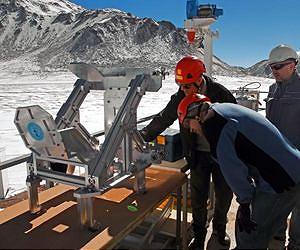
Installed on APEX earlier this year, SEPIA is sensitive to light with wavelengths in the range 1.4-1.8 millimetres. The exceptional observing conditions on the extremely dry Chajnantor Plateau in northern Chile mean that, although this light is blocked by water vapour in the atmosphere at most places on Earth, SEPIA is still able to detect the faint signals coming from space. This wavelength region is of great interest to astronomers as signals from water in space are found here. Water is an important indicator of many astrophysical processes, including the formation of stars, and is believed to play an important role in the origin of life. Studying water in space - in molecular clouds, in star-forming regions and even in comets within the Solar System - is expected to provide critical clues to the role of water in the Milky Way and in the history of the Earth. In addition, SEPIA's sensitivity makes it a powerful tool for also detecting carbon monoxide and ionised carbon in galaxies in the early Universe. The new SEPIA receiver has been used to make test astronomical observations at APEX during 2015. Identical receivers are being installed in the ALMA antennas. Results from the new detector on APEX have shown it to be working well. With this validation, SEPIA is being made available to the wider scientific community. Observations with SEPIA can now be proposed by astronomers in the community. "The first measurements with SEPIA on APEX show that we really are opening up a new window, including looking at water in interstellar space - SEPIA will give astronomers a chance to search for objectsthat can be followed up at higher spatial resolution when the same receiver becomes operational on the ALMA array," says John Conway, director of Onsala Space Observatory, Chalmers University of Technology in Sweden. Just as dark skies are essential to see faint objects in visible light, a very dry atmosphere is needed to pick up the signals from water in the cosmos at longer wavelengths. But dry conditions are not the only requirement, the detectors need to be cooled to a very low temperature of -269 degrees Celsius - just 4 degrees above absolute zero - for them to work. Recent technological advancements have only now made these detectors possible and practical. APEX, which is a collaboration between the Max Planck Institute for Radio Astronomy (MPIfR), the Onsala Space Observatory (OSO) and ESO, is the largest single-dish submillimetre telescope operating in the southern hemisphere and is based on a prototype antenna constructed for the ALMA project.
Related Links ESO Space Telescope News and Technology at Skynightly.com
|
|||||||||||||
| The content herein, unless otherwise known to be public domain, are Copyright 1995-2026 - SpaceDaily. All websites are published in Australia and are solely subject to Australian law and governed by Fair Use principals for news reporting and research purposes. By using our websites you consent to cookie based advertising. If you do not agree with this then you must stop using the websites from May 25, 2018. Privacy Statement. Additional information can be found here at About Us. |


 del.icio.us
 Digg
Digg Reddit
 Google