
 |
 |
 |
 |
 |
 |
 |
 |
 |
 |

| . |  |
. |
First Contact Within 20 Years: Shostak
Mountain View CA (SPX) Jul 22, 2004 If Intelligent life exists elsewhere in our galaxy, advances in computer processing power and radio telescope technology will ensure we detect their transmissions within two decades. That's the bold prediction from a leading light at the Search for Extraterrestrial Intelligence Institute in Mountain View, California. Seth Shostak, the SETI Institute's senior astronomer, based his prediction on accepted assumptions about the likelihood of alien civilisations existing, combined with projected increases in computing power. Shostak, whose calculations will be published in a forthcoming edition of the space science journal Acta Astronautica, first estimated the number of alien civilisations in our galaxy that might currently be broadcasting radio signals. For this he used a formula created in 1961 by astronomer Frank Drake which factors in aspects such the number of stars with planets, how many of those planets might be expected to have life, and so on. Shostak came up with an estimate of between 10,000 and 1 million radio transmitters in the galaxy. To find them will involve observing and inspecting radio emissions from most of the galaxy's 100 billion stars. The time necessary for this formidable task can be estimated from the capabilities of planned radio telescopes- such as SETI's 1-hectare Allen Telescope Array and the internationally run Square Kilometre Array- and expected increases in the power of the microchips that sift through radio signals from space. Shostak assumed that computer processing power will continue to double every 18 months until 2015- as it has done for the past 40 years. From then on, he assumes a more conservative doubling time of 36 months as transistors get too small to scale down as easily as they have till now. Within a generation, radio emissions from enough stars will be observed and analysed to find the first alien civilisation, Shostak estimates. But because they will probably be between 200 and 1000 light years away, sending a radio message back will take centuries. Paul Shuch, executive director of the SETI League, a separate organisation in New Jersey, says Shostak's prediction ignores one important factor. "It is altogether reasonable to project the development of human technology, based upon past trends and planned investments," he says. "But predicting the date, the decade or even the century of contact is another matter because the 'other end' of the communications link is completely out of our hands. It would be nice to think we know something about the existence, distribution, technology and motivation of our potential communications partners in space, but in fact, we don't." Shostak admits that there are myriad uncertainties surrounding his prediction, but he defends the basis on which he made it. "I have made this prediction using the assumptions adopted by the SETI research community itself." Related Links SETI Institute SpaceDaily Search SpaceDaily Subscribe To SpaceDaily Express
 Two Architectures Chosen for Terrestrial Planet Finder
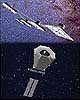 Pasadena - May 10, 2004
Included in the nation's new vision for space is a plan for NASA to "conduct advanced telescope searches for Earth-like planets and habitable environments around other stars." To meet this challenge, NASA has chosen to fly two separate missions with distinct and complementary architectures to achieve the goal of the Terrestrial Planet Finder.
--------------------------------------------------------- It's new. And it's downright terrific! Celestron's CPC Schmidt-Cassegrain telescope is the scope you've been waiting for! It offers new alignment technology, advanced engineering, and bold new design at a new, low price! In fact, Celestron's Professional Computerized (CPC) scope with revolutionary SkyAlign Alignment Technology redefines everything that amateur astronomers are looking for. It offers quick and simple alignment, GPS technology, unsurpassed optical quality, ease of use, advanced ergonomics, enhanced computerization and, most important, affordability. Want to view M-31 tonight? One button takes you there!
Shop for telescopes online at Telescopes.com! today!
|
|
|

| The content herein, unless otherwise known to be public domain, are Copyright 1995-2006 - SpaceDaily.AFP and UPI Wire Stories are copyright Agence France-Presse and United Press International. ESA PortalReports are copyright European Space Agency. All NASA sourced material is public domain. Additionalcopyrights may apply in whole or part to other bona fide parties. Advertising does not imply endorsement,agreement or approval of any opinions, statements or information provided by SpaceDaily on any Web page published or hosted by SpaceDaily. Privacy Statement |

