. 24/7 Space News .
Two Architectures Chosen for Terrestrial Planet Finder

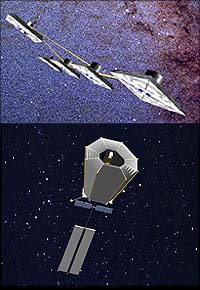
The two proposals

Pasadena - May 10, 2004
Included in the nation's new vision for space is a plan for NASA to "conduct advanced telescope searches for Earth-like planets and habitable environments around other stars." To meet this challenge, NASA has chosen to fly two separate missions with distinct and complementary architectures to achieve the goal of the Terrestrial Planet Finder.

The purpose will be to take family portraits of stars and their orbiting planets, and to study those planets to see which, if any, might be habitable, or might even have life. Both missions would launch within the next 10 to 15 years.

The two missions are:

  • Terrestrial Planet Finder-C: a moderate-sized visible-light telescope, similar to the 4- by 6-meter (13.1- by 19.6-foot) version currently under study, to launch around 2014. Onboard coronagraph instrumentation will use a central disc and other specialized techniques to block the glare of a star, allowing detection and characterization of dimmer planets around it.

  • Terrestrial Planet Finder-I: multiple spacecraft carrying 3 to 4 meter (9 to 13 foot) infrared telescopes flying in precise formation, to launch before 2020, and to be conducted jointly with the European Space Agency. Combining the infrared, or heat radiation gathered by the multiple telescopes, using a technique called interferometry, will simulate a much larger telescope. This will enable the mission to detect and study individual planets orbiting a parent star observed by TPF-C and also new ones beyond the reach of TPF-C.

  • Observing extra-solar planets in both visible and infrared light allows scientists to obtain a rich set of data to understand what chemical processes may be going on at various levels in a planet's atmosphere and surface. That leads to understanding of whether a planet ever could or actually does harbor life.

    A review of these two plans will be conducted over the summer by NASA and the National Academy of Sciences Committee on Astronomy and Astrophysics. Two other architectures that were studied, the large visible coronagraph and the structurally connected infrared interferometer, will be documented and further studies concluded this summer.

    Related Links
    Backgrounds papers, additional links and more
    SpaceDaily
    Search SpaceDaily
    Subscribe To SpaceDaily Express


    Memory Foam Mattress Review
    Newsletters :: SpaceDaily :: SpaceWar :: TerraDaily :: Energy Daily
    XML Feeds :: Space News :: Earth News :: War News :: Solar Energy News


    Life In The Universe Could Be Everywhere
    Denver CO (UPI) May 06, 2004
    The chemistry that underlies life on Earth is abundant throughout the universe -- in comets, in the interstellar medium, in the atmospheres of planets, in the outer solar system bodies and in living organisms, an astrophysicist told United Press International.

    ---------------------------------------------------------
    New from Telescopes.com!

    It's new. And it's downright terrific!

    Celestron's CPC Schmidt-Cassegrain telescope is the scope you've been waiting for! It offers new alignment technology, advanced engineering, and bold new design at a new, low price!

    In fact, Celestron's Professional Computerized (CPC) scope with revolutionary SkyAlign Alignment Technology redefines everything that amateur astronomers are looking for. It offers quick and simple alignment, GPS technology, unsurpassed optical quality, ease of use, advanced ergonomics, enhanced computerization and, most important, affordability.

    Want to view M-31 tonight? One button takes you there!

    Shop for telescopes online at Telescopes.com! today!
    ------------------------------------------------------------


  • New Bush Space Speech Planned
  • Planning for Mars, The Stafford Way
  • Lockheed Martin Considers Mixed Fleet For Launching New Space Vision
  • JFK, Bush Space Plans Similar

  • An Enduring Opportunity On Mars
  • The Spirit Of A Country Mile On Mars
  • Study May Cast Doubt On Some 1996 Evidence Of Past Life On Mars
  • Spirit Encounters New Communication Problem

  • Sea Launch Updates Lift Off Time For May 4 Launch
  • Sea Launch Sets Sail for DirecTV Mission
  • ILS To Launch 3 Satellites For SES Global Companies
  • Shuttle-Derived Vehicle: Shuttle-Derived Disaster

  • New Interpretation Of Satellite Data Supports Global Warming
  • Global Warming's Dollar Effects
  • Jose Achache: Architect To A Space Dragon
  • Purdue To Provide High-Resolution Weather Data To The Nation

  • Hubble Fails To Spot Suspected Sedna Moon
  • Life Beneath The Ice In The Outer Solar System?
  • Gravity Rules: The Nature of Planethood
  • Enigma Of Uranus Solved At Last

  • China's Lunar Probe Will Launch On Long March 3A
  • Cornell Astronomer Explains To Congress The Economics Of Lunar Water Supplies
  • Arizona Planetary Scientists Call For Lunar Exploration
  • Smart-1 Eclipse Period Over

  • Armstrong Reflects On A New Visions For Space Exploration
  • Sunny lunar mountain good site for base
  • Lunar Convoys As An Option For A Return To The Moon
  • NASA Planning Steps To Moon, Mars

  • Stanford Engineers Create GPS Steering
  • Trimble and u-Nav To Develop Next Level of GPS for Portable Electronics
  • Trimble R7 Tracks New Block IIR-M GPS Satellite Before Launch
  • XM Radio Introduces Satellite Update Service For Vehicle Navigation

  • The content herein, unless otherwise known to be public domain, are Copyright 1995-2006 - SpaceDaily.AFP and UPI Wire Stories are copyright Agence France-Presse and United Press International. ESA PortalReports are copyright European Space Agency. All NASA sourced material is public domain. Additionalcopyrights may apply in whole or part to other bona fide parties. Advertising does not imply endorsement,agreement or approval of any opinions, statements or information provided by SpaceDaily on any Web page published or hosted by SpaceDaily. Privacy Statement