|
 |
 |
 |
 |
 |
 |
 |
 |
 |

| . |  |
. |
Expect Life To Be Cold
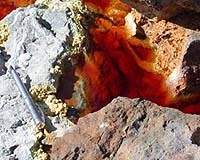
Moffett Field (SPX) May 19, 2005 In a recent talk at a NASA Astrobiology Institute (NAI) conference, Mitch Sogin, who heads the NAI's Marine Biological Laboratory team, discussed how studying microbial organisms on Earth can help scientists in the search for life on other worlds. In this second of a three-part series (See Part 1), Sogin argues that astrobiologists need to learn more about cold-adapted organisms on Earth. On other worlds in our solar system, the places we can get to most easily are frozen. In the context of looking for life elsewhere, the organisms that I think we should spend most of our time studying are the psychrophiles (cold-adapted organisms). Because life beyond Earth, at least in environments that we can access relatively easily, are likely to be cold, we have to pay attention to psychrophilic biology. This should also guide some of the decisions we make or issues we pursue regarding planetary protection. If we were to find organisms near the surface of Mars, it might well be that they have adapted to grow under very low water activities; they might even be endoliths (organisms that live inside rocks). But they will almost certainly be psychrophiles. If you go to Europa, if there are hydrothermal vent types of communities there, you might expect to find thermophiles and hyperthermophiles. And, of course barophiles (these are organisms that live at very high pressures). But closer to the surface, we'd be more likely to find psychrophiles Jody Deming's lab has found bacteria living within tiny brine pockets in sea ice. Using a DAPI stain, which stains the nucleic acids of organisms with a fluorescent dye, Deming and her colleagues have found clear evidence that there are organisms entrapped in this ice, and that they actually are growing. Diatoms, which are eukaryotes, also inhabit this environment. This affects how we need to think about planetary protection. Planetary protection is an important issue with regard to Mars, but I flip back and forth as to how important it is. With new information we have about Mars, we're left with the impression that there's a greater probability that we're going to find life on Mars and therefore that there's greater likelihood that life on Earth might be able to survive on Mars. But then I start to think about what it takes for organisms, and what we've learned about the difficulty of culturing organisms in the laboratory. And so if we deliver organisms to Mars, is it likely that they're going to find conditions that are compatible with their growth? Think of it as a laboratory experiment. I would imagine that very few of the organisms that might be delivered are going to be capable of growth. And then they have an added challenge: They're going to be delivered near the surface, and even if they were to find wet environments to live in, they still have to deal with extreme conditions that involve daily excursions through eutectic freezing points. So, how fast can these organisms possibly grow? I would grant you that some of these organisms might survive long enough to live during a future warmer, wetter period in Mars's climatic fluctuations. But I think it's unlikely that they're going to grow very quickly in today's conditions on Mars, and I don't expect them to grow to sufficient quantities that they're going to interfere with life-detection experiments over the next 50 years. When we think about exploring microbial life elsewhere in the solar system, my guess is that they're going to be cold-loving, at least the environments that we're going to have easy access to. And so, for my money, I think planetary protection, which up till now has focused on heat-resistant endospores, should be more concerned about the psychrophiles that have a chance of growing in these cold environments. Related Links SpaceDaily Search SpaceDaily Subscribe To SpaceDaily Express
 MOST Space Telescope Plays 'Hide & Seek' With An Exoplanet
 Montreal QC (SPX) May 17, 2005
MOST, Canada's first space telescope, has turned up an important clue about the atmosphere and cloud cover of a mysterious planet around another star, by playing a cosmic game of `hide and seek' as that planet moves behind its parent star in its orbit. |
|
|

| The content herein, unless otherwise known to be public domain, are Copyright 1995-2006 - SpaceDaily.AFP and UPI Wire Stories are copyright Agence France-Presse and United Press International. ESA PortalReports are copyright European Space Agency. All NASA sourced material is public domain. Additionalcopyrights may apply in whole or part to other bona fide parties. Advertising does not imply endorsement,agreement or approval of any opinions, statements or information provided by SpaceDaily on any Web page published or hosted by SpaceDaily. Privacy Statement |