| . |  |
. |
| . | |
. |


 by Staff Writers Raleigh NC (SPX) May 27, 2020
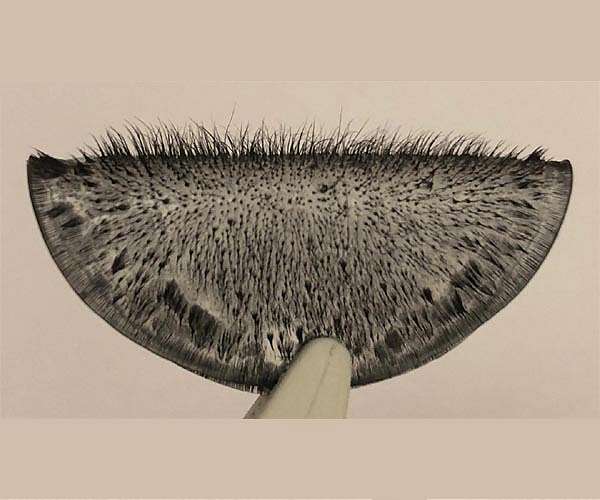
Researchers from North Carolina State University and Elon University have made artificial cilia, or hair-like structures, that can bend into new shapes in response to a magnetic field, then return to their original shape when exposed to the proper light source. "This work expands the capabilities of magnetic cilia and our understanding of their behaviors, which has potential applications in soft robotics, including microrobotics," says Joe Tracy, corresponding author of a paper on the work and a professor of materials science and engineering at NC State. "A key point of this work is that we've demonstrated shape memory magnetic cilia whose shape can be set, locked, unlocked and reconfigured. This property will be useful for enhanced and new applications." The finding builds on the team's earlier research designing soft robots that could be controlled using magnets and light. However, there are significant departures from the previous work. "The cilia are actuated by magnetic torques, which means the cilia rotate and align with the field from an inexpensive permanent magnet, instead of being pulled toward the magnet," says Ben Evans, co-author of the paper and a professor of physics at Elon. "Actuation of the soft robots in our earlier work relied on magnetic field gradients, which moved the robot by pulling it. The new approach offers another tool for designing soft robots." The researchers also developed a theoretical model that allows users to predict how the shape memory magnetic cilia will respond when actuated, or set into motion. In addition, the model explains why the cilia respond the way they do. "These shape memory magnetic cilia are also simple to fabricate through self-assembly using inexpensive permanent magnets," says Jessica Liu, first author of the paper and a recent Ph.D. graduate from NC State. "We're optimistic that these demonstrations and our model can help the research community design ciliary systems with new capabilities for specific applications." "We think this work will contribute to advancing the capabilities of soft robotics," Tracy says.
Research Report: "Photothermally Reconfigurable Shape Memory Magnetic Cilia"

The flame of discovery grows as Saffire sets new fires in space Cleveland OH (SPX) May 21, 2020 NASA ignited another set of space fire experiments last week when Saffire IV lit a number of longer, stronger flames inside Northrop Grumman's Cygnus cargo spacecraft. Saffire, NASA's Spacecraft Fire Safety Demonstration Project, is a series of six experiments that investigate how fires grow and spread in space, especially aboard future spacecraft bound for the Moon and Mars. Just like Saffires I, II and III, the researchers began the experiment in Cygnus after it completed its primary Internation ... read more
|
|||||||||||||
| The content herein, unless otherwise known to be public domain, are Copyright 1995-2026 - SpaceDaily. All websites are published in Australia and are solely subject to Australian law and governed by Fair Use principals for news reporting and research purposes. By using our websites you consent to cookie based advertising. If you do not agree with this then you must stop using the websites from May 25, 2018. Privacy Statement. Additional information can be found here at About Us. |

 del.icio.us
 Digg
Digg Reddit
 Google






