| . |  |
. |
| . | |
. |


 by Brooks Hays Washington (UPI) Jul 26, 2017
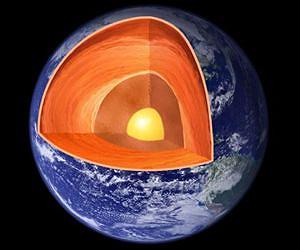
Scientists at Lawrence Livermore National Laboratory believe their improved understanding of electrical conductivity inside Earth's mantle will help them map the distribution of water inside Earth. Earth is the only planet in the solar system to develop plate tectonics and large liquid water oceans on its surface. Planetary scientists believe the distribution of significant amounts of water inside Earth's mantle is linked with the two phenomena. Understanding the diffusion of hydrogen in the mantle is key to measuring the distribution of water inside Earth. Hydrogen plays an important role in encouraging electric conductivity, but researchers haven't been able to accurately quantify the relationship between hydrogen and conductivity. To do so, scientists looked to olivine, the most abundant mineral in the upper mantle. "We approached the problem from a different perspective, using new hydrogen diffusion measurements to infer what the contribution of hydrogen would be to electrical conductivity," lead researcher Wyatt Du Frane, a scientists at LLNL, said in a news release. "Our experiments on olivine indicated a larger temperature dependence than previously thought to occur for this phenomenon. The contribution of hydrogen to electrical conductivity, while modest at lower temperatures, becomes quite large at the temperatures expected to occur in the mantle." Not only does the diffusion of hydrogen help explain the high conductivity measured in the upper mantle, it also confirms the significant concentration of dissolved water in Earth's interior. "The amount of hydrogen required to match geophysical measurements of electrical conductivity inside Earth are in line with the concentrations that are observed in oceanic basalts," Du Frane said. "This demonstrates that geophysical measurements of electrical conductivity are a promising tool for mapping out water distributions deep inside the Earth." Scientists detailed their analysis of hydrogen diffusion and conductivity in olivine in the journal Scientific Reports.
 Strength of tectonic plates may explain shape of the Tibetan Plateau
Champaign IL (SPX) Jul 25, 2017 Geoscientists have long puzzled over the mechanism that created the Tibetan Plateau, but a new study finds that the landform's history may be controlled primarily by the strength of the tectonic plates whose collision prompted its uplift. Given that the region is one of the most seismically active areas in the world, understanding the plateau's geologic history could give scientists insight to m ... read more Related Links Tectonic Science and News

|
|||||||||||||
| The content herein, unless otherwise known to be public domain, are Copyright 1995-2026 - SpaceDaily. All websites are published in Australia and are solely subject to Australian law and governed by Fair Use principals for news reporting and research purposes. By using our websites you consent to cookie based advertising. If you do not agree with this then you must stop using the websites from May 25, 2018. Privacy Statement. Additional information can be found here at About Us. |

 del.icio.us
 Digg
Digg Reddit
 Google






