| . |  |
. |
| . | |
. |


Collaboration Finds A Rolling Moon
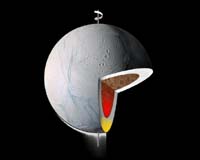
Pasadena CA (SPX) Jun 13, 2006 Bob Pappalardo gets by with a little help from his friends. Pappalardo is a newly hired JPL planetary scientist who credits a collaborative effort with colleagues for a recent unusual discovery based on images from Cassini. New research shows that Saturn's moon Enceladus - an active, icy world with an unusually warm south pole - may have performed an unusual trick for a planetary body. Enceladus literally rolled over, explaining why the moon's hottest spot is at the south pole. "It's astounding that Cassini found a region of current geological activity on an icy moon that we would expect to be frigidly cold, especially down at this moon's equivalent of Antarctica," said Pappalardo, co-author of a paper published in late May in Nature. "We think the moon rolled over to put a deeply seated warm, active area there." Pappalardo co-authored the study with Francis Nimmo, a geophysicist and assistant professor of Earth sciences at UC Santa Cruz, whose Mars research familiarizes him with a similar issue, where a big lump on the side of that planet caused Mars to "reorient" and put that lump at the equator. Nimmo and Pappalardo calculated the effects of a low-density blob beneath the surface of Enceladus and showed it could cause the moon to roll over by up to 30 degrees and put the blob at the pole. Pappalardo also credits "unspoken collaborator" Jeff Moore, his former officemate at Arizona State University and currently a planetary geologist at NASA's Ames Research Center. "Jeff and I were discussing how much Enceladus appears to be like the Uranus moon Miranda," said Pappalardo, who wrote his dissertation on Miranda. "We were just blown over when we saw the geologic activity at Enceladus' south pole and saw how the hot spot area was somewhat like one of the coronae on Miranda," he said. Coronae are circular to elliptical features marked by a ring of concentric ridges and grooves, and are thought to result from the rise of material in the planet's interior. Also, Pappalardo said, images from Cassini's Enceladus flyby in July 2005 that show the "tiger-stripe" region suggesting fault lines caused by tectonic stress are somewhat reminiscent of the coronae on Miranda. "This is an example of how you see new data and say, 'Aha, this makes sense.' A lot of this builds on the experience that comes from previous work - from knowing the literature, from understanding how it might be similar to or different from other planetary bodies. "We don't have a global map of Enceladus yet," he said, "but another interesting possibility is that maybe we'll see the evidence of other places on the surface that used to be like the hot spot is today." "I'm happy we've been able to put together this team of researchers who might not have otherwise talked about this topic," Pappalardo added. "It's satisfying and exciting for me to come back to the first real research I ever did as a graduate student, because I believe Miranda holds a lot of keys to early planetary evolution. I never would have thought we'd effectively have more information - more data - about Miranda by studying another satellite. "I think by studying Enceladus we're seeing that geology in action, which is great in science." While Pappalardo has found his Enceladus studies "thrilling," he would like to take his efforts in comparative science to another level. "My goal is to try my best to bring a Europa mission to JPL," he said. "Europa almost certainly has a global subsurface ocean. Enceladus may have liquid water in pockets and spots - it's not clear if that liquid water is global or how deep it might be - but Europa has had time to 'cook' for 4 billion years. Enceladus might get to the point where any liquid water might freeze up, but I don't know. The bottom line is that Europa has the astrobiological potential that is calling for us to get there, explore it, and understand it." Related Links JPL
 The Plumes Of Enceladus
 Pasadena CA (SPX) Jun 13, 2006
Saturn's little moon Enceladus continues to gush icy particles into orbit, making it one of a select group of geologically active bodies in the solar system, scientists at NASA's Jet Propulsion Laboratory said Monday. Enceladus (505 kilometers, or 314 miles across) is seen here against the night side of Saturn. |
|
|

| The content herein, unless otherwise known to be public domain, are Copyright 1995-2006 - SpaceDaily.AFP and UPI Wire Stories are copyright Agence France-Presse and United Press International. ESA PortalReports are copyright European Space Agency. All NASA sourced material is public domain. Additionalcopyrights may apply in whole or part to other bona fide parties. Advertising does not imply endorsement,agreement or approval of any opinions, statements or information provided by SpaceDaily on any Web page published or hosted by SpaceDaily. Privacy Statement |