| . |  |
. |
| . | |
. |


Center Seeks Information On Potential Asteroids For Mission
Fayetteville - Oct 14, 2001 University of Arkansas researchers are seeking a few good asteroids for a space mission, and they need information about these planetary bodies from scientists who study them to determine which ones make the best-suited candidates for the study. "With improved technology, we are swamped with the discovery of near-Earth asteroids," said Derek Sears, director of the Arkansas-Oklahoma Center for Space and Planetary Sciences. "What we need now is some ground-based data to help select possible asteroids for this mission." The mission, dubbed Hera after the mother of the Three Graces, would send a spacecraft to three near-Earth asteroids, collect material from them and return it to Earth for research purposes. The researchers plan to propose the mission to NASA within the next 12 months. Leon Gefert of NASA's Glenn Research Center has calculated about 60 possible trajectories for the mission, where the spacecraft would follow a path to collect samples from the three asteroids and then return to Earth From this data, Sears and his colleagues have created a "hot list" of asteroids that appear more than once in these trajectories, and now they are seeking information about them. The researchers need spectral information to determine which trio of asteroids might prove most scientifically interesting and information about the asteroids' orbits around the sun to determine the most efficient travel path to keep fuel expenditures low. Other information essential to the mission includes the asteroid's size, shape and rotation state. This will help determine where the spacecraft might land on the asteroid and how it would obtain sample material, Sears said. The researchers are also combing international databases containing information about known near-Earth asteroids for information pertinent to their mission. Related Links Sears Meteoritical Society Presentation University of Arkansas SpaceDaily Search SpaceDaily Subscribe To SpaceDaily Express
 Leonid Meteors Likely To Storm This November
  Cambridge MA - Oct 1, 2001
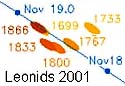
If predictions by the world's top meteor experts hold up, early on the morning of November 18th skywatchers in North America can expect to see their most dramatic meteor shower in 35 years. These meteors, called Leonids because they appear to radiate from the constellation Leo (the Lion), will signal the collision of Earth with streams of fast-moving dust particles shed by Comet Tempel-Tuttle. |
|
|

| The content herein, unless otherwise known to be public domain, are Copyright 1995-2006 - SpaceDaily.AFP and UPI Wire Stories are copyright Agence France-Presse and United Press International. ESA PortalReports are copyright European Space Agency. All NASA sourced material is public domain. Additionalcopyrights may apply in whole or part to other bona fide parties. Advertising does not imply endorsement,agreement or approval of any opinions, statements or information provided by SpaceDaily on any Web page published or hosted by SpaceDaily. Privacy Statement |

