| . |  |
. |
| . | |
. |


Leonid Meteors Likely To Storm This November
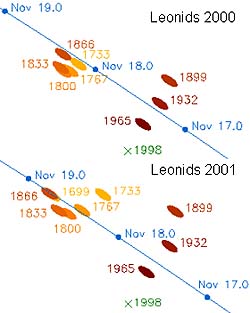
Cambridge MA - Oct 1, 2001 If predictions by the world's top meteor experts hold up, early on the morning of November 18th skywatchers in North America can expect to see their most dramatic meteor shower in 35 years. These meteors, called Leonids because they appear to radiate from the constellation Leo (the Lion), will signal the collision of Earth with streams of fast-moving dust particles shed by Comet Tempel-Tuttle. In the November 2001 Sky & Telescope -- the magazine's 60th-anniversary issue -- meteorologist Joe Rao assesses the predictions provided by three teams of specialists. Rao concludes that two dramatic displays called "meteor storms" appear likely. A burst lasting perhaps two hours is expected in the predawn hours of November 18th for observers throughout most of North and Central America. The maximum rates should occur at 5:00 a.m. EST (corresponding to 4:00 a.m. CST, 3:00 a.m. MST, 2:00 a.m. PST). With no moonlight spoiling the view, the storm may briefly generate anywhere from several hundred to 1,000 or 2,000 meteors per hour for observers with clear, dark skies. An even bigger storm arrives 8 hours later for viewers rimming the far-western Pacific Ocean. Because these locations are on the other side of the International Date Line, this peak occurs before dawn on November 19th. Several thousand meteors may streak across the sky for an hour or so starting at 3:30 or 4:30 a.m. in eastern Australia (depending on location); 2:30 a.m. in Japan; and 1:30 a.m. in western Australia, the Philippines, and eastern China. Meteors create momentary "shooting stars" when flecks of interplanetary dust strike Earth's atmosphere at high speed. The Leonids, which are one of a dozen or so annual meteor showers caused by cometary dust, arrive at a blistering 44 miles (71 kilometers) per second -- the fastest known. Typically showers produce one meteor every few minutes, though often there are bursts and lulls. Two years ago the Leonids briefly peppered the skies over Europe and the Middle East with up to 2,500 meteors per hour. In 1966 lucky observers in the southwestern United States gaped in awe for 20 minutes as Leonid meteors fell at the rate of 40 per second! More about the prospects for a Leonid storm appears in the November issue of SKY & TELESCOPE. This issue marks the diamond anniversary of the monthly magazine for amateur astronomers launched by Charles and Helen Federer in November 1941. The Federers took on the challenge of merging THE SKY (which had been published by New York's Hayden Planetarium) and THE TELESCOPE (then published by Harvard College Observatory). Today the magazine is enjoyed by some 250,000 skywatchers worldwide. Roger W. Sinnott is Senior Editor for Sky & Telescope Related Links Meteors at Sky & Telescope SpaceDaily Search SpaceDaily Subscribe To SpaceDaily Express
 NASA Spacecraft Captures Best-Ever View of Comet's Core
 Pasadena - September 25, 2001
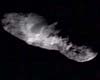
In a risky flyby, NASA's ailing Deep Space 1 spacecraft successfully navigated past a comet, giving researchers the best look ever inside the glowing core of icy dust and gas. |
|
|

| The content herein, unless otherwise known to be public domain, are Copyright 1995-2006 - SpaceDaily.AFP and UPI Wire Stories are copyright Agence France-Presse and United Press International. ESA PortalReports are copyright European Space Agency. All NASA sourced material is public domain. Additionalcopyrights may apply in whole or part to other bona fide parties. Advertising does not imply endorsement,agreement or approval of any opinions, statements or information provided by SpaceDaily on any Web page published or hosted by SpaceDaily. Privacy Statement |