| . |  |
. |
| . | |
. |


Balloons Launched Over Equatorial Brazil Validate Envisat
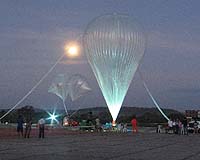
Paris (ESA) Jul 18, 2005 As part of ESA's validation and long-term monitoring programme for the atmospheric chemistry instruments on board Envisat, scientists are now facing the challenges of launching huge balloons in Equatorial Brazil to fill a gap in the validation dataset. The Teresina campaign forms part of the Envisat Stratospheric Aircraft and Balloon Campaign (ESABC) dedicated to ensuring that the measurements being made by Envisat's GOMOS, MIPAS and SCIAMACHY instruments are true. In order for the ESABC validation programme to be as complete as possible, atmospheric constituents are measured at different latitudes, and during different seasons. The Teresina balloon campaign in Brazil, which is currently well underway, focuses on gathering much-needed atmospheric data from tropical latitudes. Ten of balloons in all will be launched throughout the duration of the Teresina campaign. Each balloon carries a payload of various sensitive instruments weighing between 200 and 560 kg, which measure atmospheric constituents at the same time that Envisat passes overhead. The longest balloon flight, lasting 18 hours and carrying the MIPAS-B2 instrument, has already successfully concluded. Although stratospheric balloons provide a cost effective and efficient means of studying the atmosphere and validating measurements acquired by satellites, the practical implications of launching the balloons, which reach altitudes of up to 40 km, and recovering the payloads in remote and sometimes hostile environments are considerable. The Teresina campaign is proving no exception. Some of the equipment had been stored in Brazil over the six months prior to the campaign and unfortunately some damage had occurred. As a result, several repairs were necessary and the teams spent many long hours calibrating their instruments. Launching a balloon successfully is always weather dependent and so far there have been a few delays and interruptions in the launch programme due to strong winds. Launching the balloon is one thing but after the flight the equipment has to be recovered once it has landed back on the ground. Since these balloon campaigns generally take place in remote regions, actually getting to the landing site and transporting the payload back to the base isn't always a simple matter. In fact, during this campaign one of the cryogenic samplers was damaged during the 12-hour truck journey through rough terrain back to base. The working conditions during the Teresina campaign have, so far, been quite dangerous as some of the team members have been bitten by insects, which in a couple of instances have led to some nasty infections. They have also encountered deadly snakes and scorpions - not a job for the faint hearted! Despite the hazards and physical demands that are being put upon the team members, the Teresina campaign has so far collected some very valuable data on the tropical atmosphere that will go along way towards filling the gap in the validation dataset. Related Links Campaigns ESA's Living Planet Program SpaceDaily Search SpaceDaily Subscribe To SpaceDaily Express
 FY -2C Satellite Ready For Full Operation
 Beijing (XNA) Jul 18, 2005
Commission of Science Technology and Industry for National Defense held a handover ceremony on July 14 for China's first geostationary operational meteorological satellite successfully developed and launched by China Aerospace Science and Technology Corporation. |
|
|

| The content herein, unless otherwise known to be public domain, are Copyright 1995-2006 - SpaceDaily.AFP and UPI Wire Stories are copyright Agence France-Presse and United Press International. ESA PortalReports are copyright European Space Agency. All NASA sourced material is public domain. Additionalcopyrights may apply in whole or part to other bona fide parties. Advertising does not imply endorsement,agreement or approval of any opinions, statements or information provided by SpaceDaily on any Web page published or hosted by SpaceDaily. Privacy Statement |