| . |  |
. |
| . | |
. |


Astronomers Anticipate Meteor "Storm" This Weekend
Cambridge - Nov 8, 2001 Most everyone has glimpsed an occasional "shooting star," or meteor. But imagine what it would be like to see hundreds -- or even thousands -- of them in a single night. Such a spectacle may occur in the hours before dawn on Sunday, November 18th. In fact, if astronomers' predictions hold up, skywatchers in North America can expect to see their most dramatic meteor display in 35 years. "Earth is about to plow through a cloud of space dust that could light up our skies with celestial fireworks," notes Alan MacRobert, senior editor for Sky & Telescope magazine. These meteors, called Leonids because they appear to radiate from the constellation Leo (the Lion), will signal the arrival of fast-moving dust particles shed by Comet Tempel-Tuttle, which loops around the Sun every 33 years. Like a truck on a dirt road, the comet creates a dusty wake that spreads along its orbit. When Earth crosses that orbit in mid- November each year, skywatchers usually see a handful of shooting stars, a weak meteor "shower." But three times each century Earth crosses the dust stream where it's especially dense, and when that happens we experience what astronomers call a meteor "storm." Meteors are created when sand- or pebble-size grains strike Earth's atmosphere at high speed and create streaks of superheated air along their paths. The Leonids, which are one of a dozen or so annual meteor showers caused by streams of cometary debris, arrive at a blistering 44 miles (71 kilometers) per second -- the fastest known. Two years ago the Leonids briefly peppered the skies over Europe and the Middle East with 3,000 meteors per hour (nearly one every second). In 1966 lucky observers in the southwestern United States gaped in awe for 20 minutes as Leonid meteors fell at the rate of 40 per second! In the November 2001 issue of Sky & Telescope, meteorologist Joe Rao assesses the predictions provided by three teams of specialists, who agree that two dramatic storms appear likely this month. A burst lasting perhaps two hours is expected in the predawn hours of November 18th for observers throughout most of North and Central America. The maximum rates should occur near 5:00 a.m. EST (corresponding to 4:00 a.m. CST, 3:00 a.m. MST, 2:00 a.m. PST). With no moonlight spoiling the view, the storm may briefly spawn anywhere from several hundred to 1,000 or 2,000 meteors per hour for observers with clear, very dark skies. A fourth prediction, issued recently by NASA researcher Peter Jenniskens, argues that the hourly rate could top 4,000. An even bigger storm is expected 8 hours later for viewers rimming the far-western Pacific Ocean. Because these locations lie on the other side of the International Date Line, this peak occurs before dawn on November 19th. Several thousand meteors may streak across the sky for an hour or so starting about 3:00 or 4:00 a.m. in eastern Australia (depending on location); 2:00 a.m. in Japan; and 1:00 a.m. in western Australia, the Philippines, and eastern China. "If Earth manages to pass through a thick concentration of material," Rao notes, "the upper atmosphere can blaze with meteors storming like a fiery rain from the Sickle of Leo."
The Pundits' Predictions Peak Activity in North America (morning of November 18th)
Hourly Rate Midpoint time Midpoint time
(EST) (PST)
Asher & McNaught 800 4:55 a.m. 1:55 a.m.
Brown & Cooke 1300 8:00 a.m. 5:00 a.m.
Lyytinen & Van Flandern 2000 5:28 a.m. 2:28 a.m.
Jenniskens 4200 5:09 a.m. 2:09 a.m.
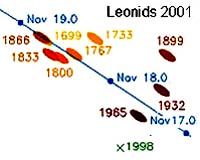
(These meteors will be dominated by dust particles shed by
Comet Tempel-Tuttle in 1767, though Brown & Cooke believe
the dominant source will be dust shed in 1799.)
Peak Activity in Asia and Australia (morning of November 19th)
Hourly Rate Midpoint time Midpoint time
(Toyko) (Sydney)
Asher & McNaught 2000 2:24 a.m. 4:24 a.m.
8000 3:13 a.m. 5:13 a.m.
Brown & Cooke 800 2:00 a.m. 4:00 a.m.
Lyytinen & Van Flandern 8500 3:15 a.m. 5:15 a.m.
Jenniskens 1800 2:08 a.m. 4:08 a.m.
2700 2:55 a.m. 4:55 a.m.
(These meteors, which may arrive in two distinct bursts,
will be dominated by particles shed by Comet Tempel-Tuttle
in 1699 and 1866, respectively)
Related LinksLeonids 2001 at Sky & Telescope SpaceDaily Search SpaceDaily Subscribe To SpaceDaily Express
 Leonid Meteor Shower Could Be One Of Best In History
 San Francisco - Nov 6, 2001
In the wee morning hours of Sunday, November 18, the Leonid meteor shower might intensify into a dazzling meteor storm, with "shooting stars" continuously blazing trails across the night sky.
--------------------------------------------------------- It's new. And it's downright terrific! Celestron's CPC Schmidt-Cassegrain telescope is the scope you've been waiting for! It offers new alignment technology, advanced engineering, and bold new design at a new, low price! In fact, Celestron's Professional Computerized (CPC) scope with revolutionary SkyAlign Alignment Technology redefines everything that amateur astronomers are looking for. It offers quick and simple alignment, GPS technology, unsurpassed optical quality, ease of use, advanced ergonomics, enhanced computerization and, most important, affordability. Want to view M-31 tonight? One button takes you there!
Shop for telescopes online at Telescopes.com! today!
|
|
|

| The content herein, unless otherwise known to be public domain, are Copyright 1995-2006 - SpaceDaily.AFP and UPI Wire Stories are copyright Agence France-Presse and United Press International. ESA PortalReports are copyright European Space Agency. All NASA sourced material is public domain. Additionalcopyrights may apply in whole or part to other bona fide parties. Advertising does not imply endorsement,agreement or approval of any opinions, statements or information provided by SpaceDaily on any Web page published or hosted by SpaceDaily. Privacy Statement |
