| . |  |
. |
| . | |
. |


Leonid Meteor Shower Could Be One Of Best In History
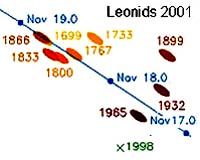
San Francisco - Nov 6, 2001 In the wee morning hours of Sunday, November 18, the Leonid meteor shower might intensify into a dazzling meteor storm, with "shooting stars" continuously blazing trails across the night sky. Viewers across the United States are perfectly positioned to take advantage of the storm, which could be among the most spectacular sky events of the 21st century according to the latest scientific predictions. The peak in shower activity will occur between 4:00 and 6:00 a.m. EST, or 1:00 and 3:00 a.m. PST on Sunday morning, November 18. "During the peak, people viewing under clear and dark skies could see meteors shooting across the sky at a rate of 1,000 to 2,000 per hour, with flurries of one meteor per second at the peak of the storm," says Robert Naeye, Editor of Mercury magazine, which is published in San Francisco by the Astronomical Society of the Pacific (ASP). During the predicted storm, Earth will plow through a trail of tiny dust particles left behind by Comet Tempel- Tuttle during its passage through the inner solar system in the year 1767. This comet rounds the Sun every 33.25 years, shedding dust particles as it is warmed by sunlight. Meteor showers occur when Earth passes through debris left behind by comets. But meteor storms occur when Earth passes through particularly dense ribbons of comet debris. "During a typical Leonid meteor shower, an experienced observer might see about 10 to 15 meteors per hour. But during a storm, that rate climbs to 1,000 or more meteors per hour," says Naeye. "This year's Leonid storm might peak at a rate of up to 2,000 per hour, although it's difficult to pin down a precise number. The rates will rise and fall over a period of two hours." "Of course, these numbers depend on the accuracy of our predictions. But the predictions have been remarkably accurate in recent years," says ASP member Dr. Peter Jenniskens, an astronomer and meteor researcher at the SETI Institute in Mountain View, California, and author of an in-depth article about meteor science in the November/December 2001 issue of Mercury magazine. This year's Leonid display has two added bonuses. The Moon will rise during daylight and set six hours before the peak, so the Moon's glare will not obscure fainter meteors. In addition, the peak will occur on a Sunday morning, so many people can sleep in after a long night of skygazing. If one mentally traces back the trajectory of Leonid meteors, they appear to originate in the constellation Leo (the Lion). Leo rises around midnight, so the shower will be minimal in the hours immediately after sunset. But it will pick up considerably as the night progresses. The entire United States should enjoy a good shower. Peak meteor rates should occur around 5:00 a.m. EST, 4:00 a.m. CST, 3:00 a.m. MST, and 2:00 a.m. PST. Observers in eastern Asia and the Western Pacific will also enjoy a storm approximately 8 hours later (in the morning hours of November 19, local time), according to the forecasts. For the latest predictions for your local area, visit this website from NASA's Ames Research Center. Earth will encounter another dense ribbon of Comet Tempel-Tuttle debris in 2002, but under a full Moon. After that, it's over for nearly a century. "It's now or never," stresses Naeye. "People should take advantage of this year's Leonid storm, because astronomers don't think we'll see another storm like this one until the year 2099. We will probably never see a better meteor shower in our lifetimes." When you see meteors, popularly known as "shooting stars," you're seeing interplanetary dust particles burning up in the atmosphere at altitudes of about 60 to 70 miles. A typical comet dust particle --known as a meteoroid-- is only about the size of a grain of sand or a pebble when it enters the atmosphere. Larger chunks of comet debris, perhaps up to the sizes of basketballs, sometimes light up the sky as they burn up, which are events called fireballs or bolides. Leonids enter the atmosphere at 160,000 miles per hour, making them the fastest meteors of the year. "Shooting stars are for every man, woman, and child to see, and it doesn't take any special equipment to see them," says Jane Houston Jones, a member of the ASP Board of Directors and an experienced meteor observer. "Most Leonid meteors are faint, so you'll see more of them if you are far away from city light pollution. "If you can't get to a dark site, then control your own light pollution by turning out as many lights as you can control. Then sit back in a lawn chair, bundle up in a blanket, and at a little before midnight local time, face east. You'll see the backwards question-mark shape of Leo's mane rising, and that's where the meteors will appear to radiate over the next few hours." Meteors are beautiful sky events for skygazers. But for scientists, meteors are fascinating in their own right. "Meteor science involves more than just predicting storms. We also want to learn about the meteoroids themselves, which in turn tell us a great deal about the parent comet," says Jenniskens. "We also want to learn more how meteors may have brought critical organic material to Earth, perhaps leading to the origin and prevalence of life on our planet." Related Links The Astronomical Society of the Pacific Local Leonid Estimator Leonids In The Southern Hemisphere SpaceDaily Search SpaceDaily Subscribe To SpaceDaily Express
 Observations Reveal Curiosities On The Surface Of Asteroid Ceres
  Boulder - Nov 2, 2001
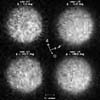
An international team led by scientists at the Southwest Research Institute (SwRI) has discovered some curious properties of the largest asteroid, Ceres. |
|
|

| The content herein, unless otherwise known to be public domain, are Copyright 1995-2006 - SpaceDaily.AFP and UPI Wire Stories are copyright Agence France-Presse and United Press International. ESA PortalReports are copyright European Space Agency. All NASA sourced material is public domain. Additionalcopyrights may apply in whole or part to other bona fide parties. Advertising does not imply endorsement,agreement or approval of any opinions, statements or information provided by SpaceDaily on any Web page published or hosted by SpaceDaily. Privacy Statement |