| . |  |
. |
| . | |
. |


 by Staff Writers Thuwal, Saudi Arabia (SPX) Jun 02, 2021
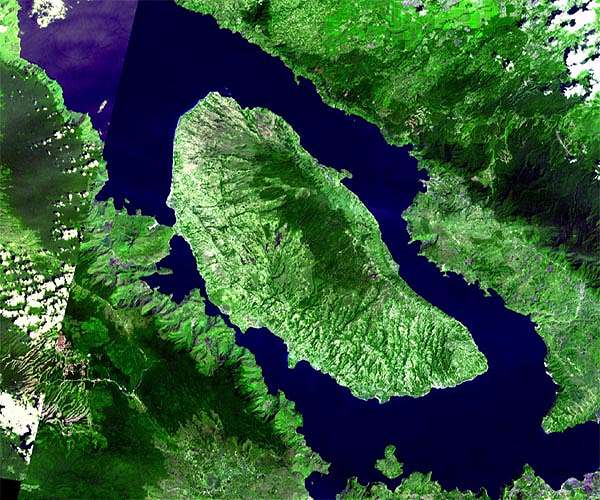
A catastrophic drop in atmospheric ozone levels around the tropics is likely to have contributed to a bottleneck in the human population around 60 to 100,000 years ago, an international research team has suggested. The ozone loss, triggered by the eruption of the Toba supervolcano located in present-day Indonesia, might solve an evolutionary puzzle that scientists have been debating for decades. "Toba has long been posited as a cause of the bottleneck, but initial investigations into the climate variables of temperature and precipitation provided no concrete evidence of a devastating effect on humankind," says Sergey Osipov at the Max Planck Institute for Chemistry, who worked on the project with KAUST's Georgiy Stenchikov and colleagues from King Saud University, NASA and the Max Planck Institute for Chemistry. "We point out that, in the tropics, near-surface ultraviolet (UV) radiation is the driving evolutionary factor. Climate becomes more relevant in the more volatile regions away from the tropics," says Stenchikov. Large volcanic eruptions emit gases and ash that create a sunlight-attenuating aerosol layer in the stratosphere, causing cooling at the Earth's surface. This "volcanic winter" has multiple knock-on effects, such as cooler oceans, prolonged El Nino events, crop failures and disease. "The ozone layer prevents high levels of harmful UV radiation reaching the surface," says Osipov. "To generate ozone from oxygen in the atmosphere, photons are needed to break the O2 bond. When a volcano releases vast amounts of sulfur dioxide (SO2), the resulting volcanic plume absorbs UV radiation but blocks sunlight. This limits ozone formation, creating an ozone hole and heightening the chances of UV stress." The team examined UV radiation levels after the Toba eruption using the ModelE climate model developed by NASA GISS (Goddard Institute for Space Studies). They simulated the possible after-effects of different sizes of eruptions. Running such a model is computationally intensive, and Osipov is grateful for the use of KAUST's supercomputer, Shaheen II, and associated expertise. Their model suggests that the Toba SO2 cloud depleted global ozone levels by as much as 50 percent. Furthermore, they found that the effects on ozone are significant, even under relatively small eruption scenarios. The resulting health hazards from higher UV radiation at the surface would have significantly affected human survival rates. "The UV stress effects could be similar to the aftermath of a nuclear war," says Osipov. "For example, crop yields and marine productivity would drop due to UV sterilization effects. Going outside without UV protection would cause eye damage and sunburn in less than 15 minutes. Over time, skin cancers and general DNA damage would have led to population decline."
|
|||||||||||||
| The content herein, unless otherwise known to be public domain, are Copyright 1995-2026 - SpaceDaily. All websites are published in Australia and are solely subject to Australian law and governed by Fair Use principals for news reporting and research purposes. By using our websites you consent to cookie based advertising. If you do not agree with this then you must stop using the websites from May 25, 2018. Privacy Statement. Additional information can be found here at About Us. |

 del.icio.us
 Digg
Digg Reddit
 Google







