| . |  |
. |
| . | |
. |


 by Brooks Hays Washington DC (UPI) Apr 02, 2018
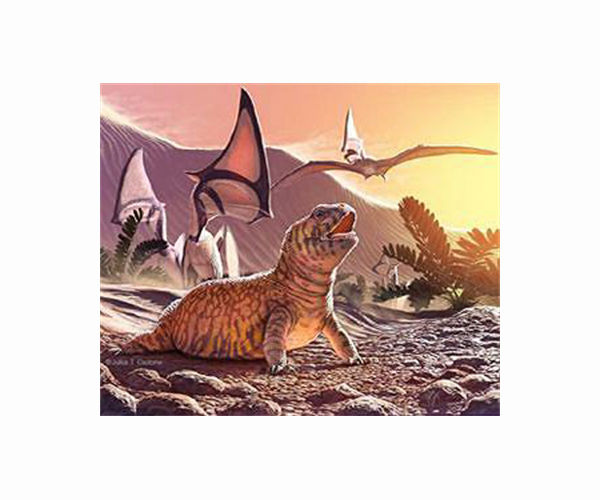
Scientists have discovered the first jawed vertebrate with four eyes. The fossil of an extinct species of monitor lizard revealed the presence of a third and fourth eye on top of the reptile's head. The two eyes are actually eye-like photosensory structures known as pineal and parapineal organs. Researchers believe the structures helped the lizard maintain its orientation and circadian rhythm. Only the jawless lamprey is known to utilize four eyes, today. The ancient monitor lizard is the only known jawed vertebrate with an extra set of photosensory structures. "On the one hand, there was this idea that the third eye was simply reduced independently in many different vertebrate groups such as mammals and birds and is retained only in lizards among fully land-dwelling vertebrates," Krister Smith, scientist at the Senckenberg Research Institute in Germany, said in a news release. "On the other hand, there was this idea that the lizard third eye developed from a different organ, called the parapineal, which is well developed in lampreys. These two ideas didn't really cohere." Third eyes known as pineal organisms are common among fishes and frogs. Analysis of the extinct lizard species produced contradictory conclusions about the location of the species' third eye. As a result, researchers hypothesized the species hosted a fourth eye, too. To test their hypothesis, scientists analyzed fossil specimens collected 150 years ago from Grizzly Buttes in Wyoming's Wind River Basin. CT scans of the lizard fossils proved the hypothesis correct. The extinct monitor lizard, Saniwa ensidens, which lived during the middle Eocene, between about 52 and 49 million years ago, hosted both pineal and parapineal organs. Researchers described their discovery in a new paper published this week in the journal Current Biology. The study offered another reminder that fossil collections in museums around the world are hiding numerous surprises. "The fossils that we studied were collected in 1871, and they are quite scrappy -- really banged up," Smith said. "One would be forgiven for looking at them and thinking that they must be useless. Our work shows that even small, fragmentary fossils can be enormously useful."

Earth's water present before impact formed moon, study finds Washington (UPI) Mar 29, 2018 Based on an extensive collection of lunar and terrestrial samples, researchers have determined that most of the water on Earth was already present at the time of the impact that created the moon. Scientists from the United States, Britain and France studied moon rocks brought back to Earth by astronauts on the six Apollo missions and volcanic rocks retrieved from the ocean floor by Earth-bound scientists. They published their findings Thursday in the journal Science Advances. "The resear ... read more
|
|||||||||||||
| The content herein, unless otherwise known to be public domain, are Copyright 1995-2026 - SpaceDaily. All websites are published in Australia and are solely subject to Australian law and governed by Fair Use principals for news reporting and research purposes. By using our websites you consent to cookie based advertising. If you do not agree with this then you must stop using the websites from May 25, 2018. Privacy Statement. Additional information can be found here at About Us. |

 del.icio.us
 Digg
Digg Reddit
 Google







