| . |  |
. |
| . | |
. |


 by Staff Writers Edmonton, Canada (SPX) Dec 03, 2019
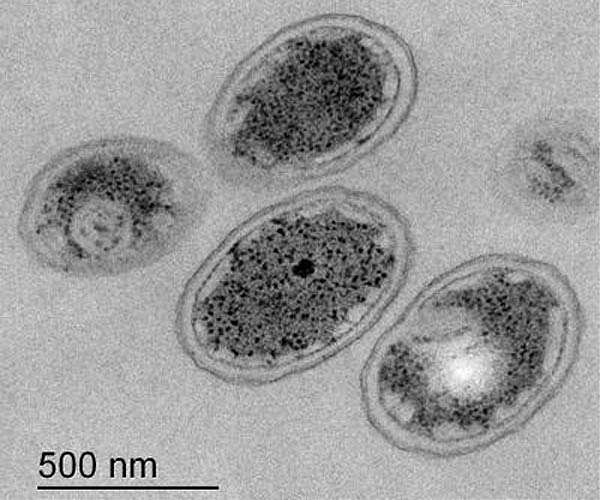
Ancient ancestors of modern microbes played a critical role in setting the stage for life on a dimly lit early Earth, and in creating the world's largest iron ore deposits, according to new research. The study, conducted by an international consortium of researchers including the University of Alberta and the University of British Columbia, examined modern bacteria from an iron-rich lake in the Democratic Republic of Congo. Results show that these ancient microbes may have been key to keeping Earth's early climate warm while simultaneously forming massive iron-rich deposits. "These ancient microorganisms used energy from the sun to transform iron into rusty minerals, without oxygen," said Kurt Konhauser, professor in the Department of Earth and Atmospheric Sciences and co-author on the study. "They also served as a source of food for other microbes, which then produced methane, helping to warm Earth's early atmosphere." In the Precambrian era, sunlight on Earth was much less bright than it is today because the sun itself was less luminous. The research supports that the methane created by the consumption of these microbes helped to keep the planet's atmosphere warm, setting the stage for other forms of early life. "The fundamental knowledge we're gaining from studies using modern geomicrobiological tools and techniques is transforming our view of Earth's history as well as how we know and interact with the world around us today," said Katharine Thompson, lead author of the study and PhD student in the Department of Microbiology and Immunology at UBC. The research also has applications for Earth's current and future climate, as well. Understanding how life and the solid Earth interact not only has the potential to inform about possible environmental feedbacks, but the processes that caused Earth's early warming has relevance for large-scale remediation efforts, such as removing carbon dioxide from the atmosphere through bacteria-mineral interactions. This research was conducted in collaboration with the University of British Columbia, the University of Tubingen, Universitat Auto?noma de Barcelona, and the Georgia Institute of Technology. The paper, "Photoferrotrophy, deposition of banded iron formations, and methane production in Archean oceans," was published in Science Advances.
Breathing? Thank volcanoes, tectonics and bacteria Houston TX (SPX) Dec 03, 2019 Earth's breathable atmosphere is key for life, and a new study suggests that the first burst of oxygen was added by a spate of volcanic eruptions brought about by tectonics. The study by geoscientists at Rice University offers a new theory to help explain the appearance of significant concentrations of oxygen in Earth's atmosphere about 2.5 billion years ago, something scientists call the Great Oxidation Event (GOE). The research appears this week in Nature Geoscience. "What makes this uniqu ... read more
|
|||||||||||||
| The content herein, unless otherwise known to be public domain, are Copyright 1995-2026 - SpaceDaily. All websites are published in Australia and are solely subject to Australian law and governed by Fair Use principals for news reporting and research purposes. By using our websites you consent to cookie based advertising. If you do not agree with this then you must stop using the websites from May 25, 2018. Privacy Statement. Additional information can be found here at About Us. |

 del.icio.us
 Digg
Digg Reddit
 Google







