| . |  |
. |
| . | |
. |


Ancient DNA Traces The Woolly Mammoth Disappearance
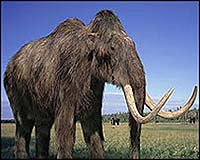
London UK (SPX) Jun 18, 2007 Some ancient-DNA evidence has offered new clues to a very cold case: the disappearance of the last woolly mammoths, one of the most iconic of all Ice Age giants, according to a June 7th report published online in Current Biology, a publication of Cell Press. DNA lifted from the bones, teeth, and tusks of the extinct mammoths revealed a "genetic signature" of a range expansion after the last interglacial period. After the mammoths' migration, the population apparently leveled off, and one of two lineages died out. "In combination with the results on other species, a picture is emerging of extinction not as a sudden event at the end of the last ice age, but as a piecemeal process over tens of thousands of years involving progressive loss of genetic diversity," said Dr. Ian Barnes, of Royal Holloway, University of London. "For the mammoth, this seems much more likely to have been driven by environmental rather than human causes, even if humans might have been responsible for killing off the small, terminal populations that were left." Barnes, along with Dr. Adrian Lister of the University College London and the Natural History Museum in London and others, had earlier found evidence that bison, bears, and lions underwent major population shifts twenty-five to fifty thousand years ago. Those results came as a surprise, the researchers said, because scientists tended to think that the major environmental changes happened about fifteen to twenty-five thousand years ago, when the glaciers reached their fullest extent. The findings also offered early human hunters a potential alibi; they didn't come on the scene in large numbers until even later. In search of a general pattern in the new study, Barnes and Lister's team looked to the extinct woolly mammoth. What they found, however, was an "interesting pattern, not like those of the other species." Their genetic data indicate that Siberian mammoths expanded from a small base some time before sixty thousand years ago. Moreover, they found two distinct genetic groups, implying that mammoths had diverged in isolation for some time before merging back into a single population. The DNA further suggests that no later than forty thousand years ago, one of the groups died out, leaving only the second alive at the time of the mammoth's last gasp. "At a time when we should be very concerned about the potential extinction of many existing large mammals, studying those that occurred in the geologically recent past can provide many insights," Lister said. "Our work, together with that of others, shows that the conditions for extinction can be set up long before the actual extinction event." The researchers include Ian Barnes of Royal Holloway, University of London in Surrey, UK; Beth Shapiro of University of Oxford in Oxford, UK; Mark G. Thomas of University College London in London, UK; Adrian Lister of the Natural History Museum and University College London in London, UK;Tatiana Kuznetsova of Moscow State University in Moscow, Russia; Andrei Sher of Severtsov Institute of Ecology and Evolution, Russian Academy of Sciences in Moscow, Russia; Dale Guthrie University of Alaska in Fairbanks, Alaska. Barnes et al.: "Genetic Structure and Extinction of the Woolly Mammoth, Mammuthus primigenius." Publishing in Current Biology 17, 1-4, June 19, 2007. DOI 10.1016/j.cub.2007.05.035. www.current-biology.com Email This Article
Related Links
 Book Makes Case For Using Evolution In Everyday Life
 Binghamton, NY (SPX) Jun 18, 2007
Evolution is not just about human origins, dinosaurs and fossils, says Binghamton University evolutionist David Sloan Wilson. It can also be applied to almost every aspect of human life, as he demonstrates in his first book for a general audience, Evolution for Everyone: How Darwin's Theory Can Change the Way We Think About Our Lives (Bantam Press 2007). |
|
|

| The content herein, unless otherwise known to be public domain, are Copyright 1995-2006 - SpaceDaily.AFP and UPI Wire Stories are copyright Agence France-Presse and United Press International. ESA PortalReports are copyright European Space Agency. All NASA sourced material is public domain. Additionalcopyrights may apply in whole or part to other bona fide parties. Advertising does not imply endorsement,agreement or approval of any opinions, statements or information provided by SpaceDaily on any Web page published or hosted by SpaceDaily. Privacy Statement |