| . |  |
. |
| . | |
. |


 by Staff Writers Washington DC (SPX) Apr 16, 2018
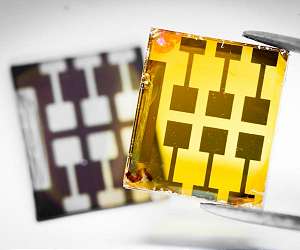
Trapping light with an optical version of a whispering gallery, researchers at the National Institute of Standards and Technology (NIST) have developed a nanoscale coating for solar cells that enables them to absorb about 20 percent more sunlight than uncoated devices. The coating, applied with a technique that could be incorporated into manufacturing, opens a new path for developing low-cost, high-efficiency solar cells with abundant, renewable and environmentally friendly materials. The coating consists of thousands of tiny glass beads, only about one-hundredth the width of a human hair. When sunlight hits the coating, the light waves are steered around the nanoscale bead, similar to the way sound waves travel around a curved wall such as the dome in St. Paul's Cathedral in London. At such curved structures, known as acoustic whispering galleries, a person standing near one part of the wall easily hears a faint sound originating at any other part of the wall. Whispering galleries for light were developed about a decade ago, but researchers have only recently explored their use in solar-cell coatings. In the experimental set up devised by a team including Dongheon Ha of NIST and the University of Maryland's NanoCenter, the light captured by the nanoresonator coating eventually leaks out and is absorbed by an underlying solar cell made of gallium arsenide. Using a laser as a light source to excite individual nanoresonators in the coating, the team found that the coated solar cells absorbed, on average, 20 percent more visible light than bare cells. The measurements also revealed that the coated cells produced about 20 percent more current. The study is the first to demonstrate the efficiency of the coatings using precision nanoscale measurements, said Ha. "Although calculations had suggested the coatings would enhance the solar cells, we could not prove this was the case until we had developed the nanoscale measurement technologies that were needed," he noted. This work was described in a recent issue of Nanotechnology by Ha, collaborator Yohan Yoon of NIST and Maryland's NanoCenter, and NIST physicist Nikolai Zhitenev. The team also devised a rapid, less-costly method of applying the nanoresonator coating. Researchers had previously coated semiconductor material by dipping it in a tub of the nanoresonator solution. The dipping method takes time and coats both sides of the semiconductor even though only one side requires the treatment. In the team's method, droplets of the nanoresonator solution are placed on just one side of the solar cell. A wire-wound metal rod is then pulled across the cell, spreading out the solution and forming a coating made of closely packed nanoresonators. This is the first time that researchers have applied the rod method, used for more than a century to coat material in a factory setting, to a gallium arsenide solar cell. "This is an inexpensive process and is compatible with mass production," said Ha. Dongheon Ha, Yohan Yoon and Nikolai B Zhitenev. Nanoscale imaging of photocurrent enhancement by resonator array photovoltaic coatings. Nanotechnology. Published 15 February 2018. DOI: 10.1088/1361-6528/aaab0c
Double perovskites in environmentally friendly solar cells Linkoping, Sweden (SPX) Apr 12, 2018 A further step has been taken along the road to manufacturing solar cells from lead-free perovskites. High quality films based on double perovskites, which show promising photovoltaic properties, have been developed in collaboration between Linkoping University, Sweden, and Nanyang Technological University in Singapore. Research groups around the world have recognised the potential of perovskites as one of the most promising materials for the development of cheap, environmentally friendly and effi ... read more
|
|||||||||||||
| The content herein, unless otherwise known to be public domain, are Copyright 1995-2026 - SpaceDaily. All websites are published in Australia and are solely subject to Australian law and governed by Fair Use principals for news reporting and research purposes. By using our websites you consent to cookie based advertising. If you do not agree with this then you must stop using the websites from May 25, 2018. Privacy Statement. Additional information can be found here at About Us. |

 del.icio.us
 Digg
Digg Reddit
 Google







