| . |  |
. |
| . | |
. |


 by Staff Writers Vienna, Austria (SPX) Oct 18, 2018
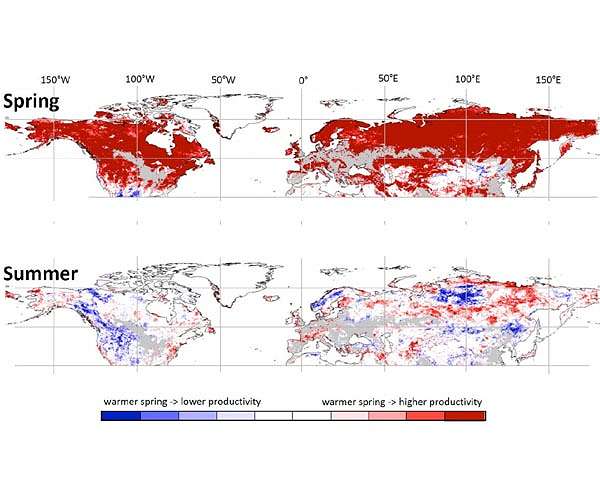
Climate change influences plant growth, with springtime growth beginning earlier each year. Up to now, it was thought that this phenomenon was slowing climate change, as scientists believed this process led to more carbon being absorbed from the atmosphere for photosynthesis and more biomass production. However, as evaluations of satellite data undertaken at TU Wien have now shown, this is not the case. On the contrary, in many regions, an early spring actually leads to less plant growth. The climate models that have been used until now need to be modified and the world's climate is in an even more critical state than previously thought. The results have now been published in a large international study in the science journal Nature.
Satellite data: how green is the Earth? For the first time, we have been able to investigate the global patterns of this effect by using satellite data. "We analysed satellite images from the past 30 years, examining the entire globe to the north of the 30th parallel north, from southern Europe and Japan to the most northerly tundra regions," says Matthias Forkel. In areas of high vegetation, light is strongly absorbed, and infrared radiation is strongly reflected. "This means that we can determine how much photosynthesis is occurring and how much carbon is taken up during photosynthesis across the globe on a point-by-point basis," explains Forkel. These data analyses were carried out at the University of Leeds in the UK and at TU Wien, with the additional involvement of climate and environmental research teams from the USA and several other countries.
A warm spring - a drier autumn There may be a range of reasons for this: greater plant growth in the spring may increase transpiration and the demand for water which in turn decreases soil moisture content and results in insufficient water being available to plants later in the year. It is possible that certain plants also have a predetermined growth period that is not extended by the earlier onset of growth. "These mechanisms are complicated and vary on a regional basis," says Matthias Forkel. "However, our data clearly shows that average plant productivity decreases during years that experience a warm spring."
Climate change with even more severe consequences
Conflict and drought ravage Iraq's prized date palms Basra, Iraq (AFP) Oct 05, 2018 Sweet Iraqi dates adorn tables in homes across the country, but the fruit tree and national symbol has come under threat from conflict and crippling drought. Shopping in the southern city of Basra, Leila only buys "the queen of dates" - those produced in the surrounding province. Her husband Mehdi, 68, said the couple have the sweet fruit "every lunchtime, and also for snacks between meals". The pair devours a kilo (two pounds) over two to three days, at a cost of 5,000 dinars, or just over ... read more
|
|||||||||||||
| The content herein, unless otherwise known to be public domain, are Copyright 1995-2026 - SpaceDaily. All websites are published in Australia and are solely subject to Australian law and governed by Fair Use principals for news reporting and research purposes. By using our websites you consent to cookie based advertising. If you do not agree with this then you must stop using the websites from May 25, 2018. Privacy Statement. Additional information can be found here at About Us. |

 del.icio.us
 Digg
Digg Reddit
 Google







