| . |  |
. |
| . | |
. |


 by An Li, Student Collaborator on PIXL at University of Washington Pasadena CA (JPL) Nov 24, 2022
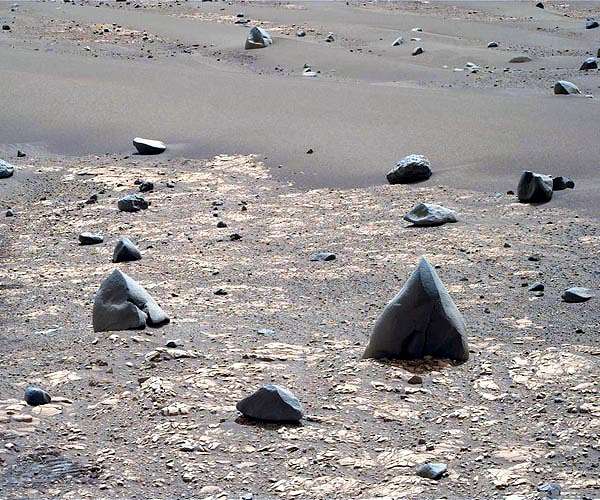
From the image Perseverance recently took at Yori Pass, we can see that there are gray rocks scattered on top of a tan colored rock surface below. What do these different colors tell us? As planetary geologists, our job is to figure out through physical and chemical observations the story that these rocks tell us about Yori Pass and its place within the delta in Jezero Crater. Color is one of the first clues we can use that might hint at how the rocks formed. When we see different colors like in this case, we might suspect that the two types of rocks had different origins. Other physical characteristics include size, angularity, texture, and context, which we can all use to piece together how the rocks got to be the way they are today. For example, the gray, more angular (sharper-edged) rocks sitting on top appear similar in appearance to an outcrop the rover has passed in another area called Boston Knob. The geologic term for this kind of rock at Yori Pass that sits on top is a "float rock" because it looks like it was transported here rather than forming in place. A few mechanisms by which this might happen include ejecta from crater impacts, entrainment in glaciers, or transport by wind or water. Considering the color of the underlying rock, the rock below appears more consistent with the type of terrain seen at other outcrops of the delta that might be fine-grained and likely to contain clay minerals. Clay minerals formed in the delta are exciting for potential preservation of biosignatures. Both types of rocks seen here at Yori Pass are interesting, though for different reasons because they may each point to different conditions and times within the history of the delta. We have just started studying this new area at Yori Pass. On sol 614 (November 11, 2022), we performed proximity science using the PIXL and SHERLOC instruments on an abraded surface of the tan colored rocks, so we are looking forward to using the results to better constrain the chemical composition to determine whether we should sample here!

Reading the ripples at observation mountain Pasadena CA (JPL) Nov 23, 2022 After spending over 600 sols (days on Mars) exploring the diverse geologic environment of Jezero Crater, collecting drilled rock cores (and one atmospheric sample) along the way, Perseverance recently spent some time parked near a large sand ripple named "Observation Mountain," with sights set on something widespread yet unique. Regolith is the sandy, dusty, loose material covering much of the Martian surface, and is made up of many small rock fragments - some of which are sourced from across the planet ... read more
|
|||||||||||||
| The content herein, unless otherwise known to be public domain, are Copyright 1995-2026 - SpaceDaily. All websites are published in Australia and are solely subject to Australian law and governed by Fair Use principals for news reporting and research purposes. By using our websites you consent to cookie based advertising. If you do not agree with this then you must stop using the websites from May 25, 2018. Privacy Statement. Additional information can be found here at About Us. |

 del.icio.us
 Digg
Digg Reddit
 Google






