| . |  |
. |
| . | |
. |


 by Staff Writers Lincoln UK (SPX) Nov 26, 2019
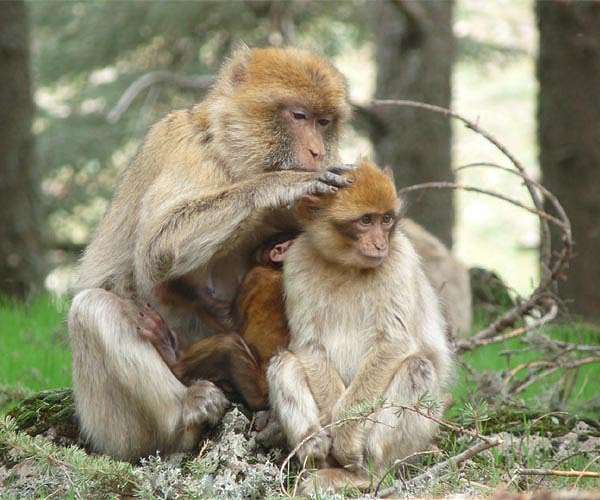
The study, which looks specifically at the behaviour of an endangered monkey species, reveals that even in national parks where human presence is reduced and regulated, the animals carry out careful calculations and modify their natural behaviour to balance the pros and cons of living in close proximity to humans. It reveals the negative impact that consuming human foods can have on the physical health of the monkeys, and highlights the need for new and sustainable conservation programmes to save the growing number of endangered species in their natural habitats. Barbary macaques are an endangered species of monkeys restricted to the forests of Morocco and Algeria, with an introduced population also living on the Rock of Gibraltar. The wild population in North Africa has dramatically declined in the last decades. The new study, led by Dr Bonaventura Majolo from the University of Lincoln, UK, involved a detailed examination of the effects of human activity on wild Barbary macaques in Ifrane National Park in Morocco. Dr Majolo said: "When we observe animals in the wild we often talk about a 'landscape of fear'. This term refers to the decisions that animals make when they choose whether or not to avoid an area where the risk of predation is highest; weighing up the risk of attack against the possible rewards to be found there. "Our study shows that macaques make many behavioural adjustments in response to varying levels of risk and reward, and that the way the macaques respond to human activity is very similar to the way in which they respond to predation risk. We see evidence here that the macaques are capable of great behavioural flexibility as they navigate the problems and the opportunities that sharing space with humans presents." The researchers followed five groups of Barbary macaques and observed their behaviour and habitat selection over the course of a year. Their findings reveal the true extent of human activity on the monkeys' habitats and choices. The researchers observed the macaques making significant adjustments to their behaviour and navigating their environment strategically in relation to human activity. They appear to balance food acquisition and risk avoidance - for example they minimise risk by avoiding areas used by local shepherds and their dogs (which are now among the monkeys' most dangerous predators), and exploit opportunities to receive high-calorie human food by spending time close to roads. Although being fed by humans may appear to be beneficial for the monkeys, food provisioning in fact has negative impacts on the macaques - increasing their stress levels, heightening the probability of road injury and death, and having a detrimental impact on their health. The monkeys' behaviour also shows seasonal trends in correlation with human activities. The macaques avoid herding routes during summer months, when herding activity by the local shepherds is at its peak, and they are more likely to use areas close to roads in the autumn and winter months, when natural food sources are low and the benefits of receiving high calorie human food may exceed the risk of being injured or even killed by road traffic. The study reveals that the 'home range' of each observed macaque group (the area where a group of monkeys spend most of their time) included some kind of human structure, from roads and paths to picnic areas and farms. They also found that all of the study group's home ranges overlapped with at least one other, which the researchers conclude could be a result of declining availability of suitable habitats and food sources, or of direct competition over profitable areas close to roads and safe sleeping sites. Their findings are published in the scientific journal Animal Conservation. James Waterman, first author of the paper and a PhD student at Liverpool John Moores University, said: "Even in a national park, the effect of human disturbance on animal life can be considerable, and as our landscapes become increasingly human dominated, many wildlife species must cope with new ecological pressures. The impact of habitat loss and fragmentation, climate change, expanding human infrastructure, hunting and poaching quickly and dramatically alters habitats, forcing wildlife to adjust, move to more suitable areas (if these are available), or ultimately face the threat of extinction. "This study highlights that it is more important than ever to develop conservation programs that take into account the requirements of all involved, including, but not limited to the wildlife that is ultimately at risk. Programs that fail to do so rarely produce lasting, positive change." Dr Majolo concludes: "The good news is that we see certain species, like these monkeys, adapting in impressive and intelligent ways to increasing levels of human activity. The bad news is that this flexibility may only take them so far as habitats continue to shrink, and contact with humans becomes harder to avoid. We have a responsibility to try to understand the limits of this flexibility and find sustainable solutions for human-wildlife co-existence before that point is reached, and we risk losing them for good."
Skull study suggests pre-humans weren't as bright as modern apes Washington (UPI) Nov 13, 2019 New research suggests it wasn't superior intelligence that set our earliest pre-human ancestors, like Australopithecus, apart from apes. For the study, scientists analyzed holes in the skull that allow the passage of supply arteries to the brain, calculating blood flow to the cognitive part of the brain. Researchers calibrated their estimates using humans and other mammal models, and then applied their calculations to 96 great ape skulls and 11 Australopithecus fossil skulls. The data -- ... read more
|
|||||||||||||
| The content herein, unless otherwise known to be public domain, are Copyright 1995-2026 - SpaceDaily. All websites are published in Australia and are solely subject to Australian law and governed by Fair Use principals for news reporting and research purposes. By using our websites you consent to cookie based advertising. If you do not agree with this then you must stop using the websites from May 25, 2018. Privacy Statement. Additional information can be found here at About Us. |

 del.icio.us
 Digg
Digg Reddit
 Google







