. 24/7 Space News .
INTERN DAILY
A cheap, disposable device for diagnosing disease
by Staff Writers
University Park PA (SPX) Dec 08, 2015


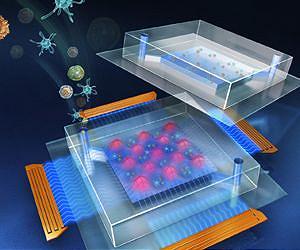
The cover image of the current issue of the journal Lab on a Chip shows an artist's conception of a reusable acoustic tweezers device (bottom) with a disposable microfluidic laboratory for cell manipulation and disease diagnosis. Image courtesy Huang Lab and Penn State. For a larger version of this image please go here.

The development of a reusable microfluidic device for sorting and manipulating cells and other micro/nano meter scale objects will make biomedical diagnosis of diseases cheaper and more convenient in regions where medical facilities are sparse or cost is prohibitive. Researchers at Penn State have recently filed a patent to develop such a device.

Based on gentle acoustic vibrations, the device, called acoustic tweezers, is the work of Penn State professor of engineering science and mechanics, Tony Huang and his students. Their work is the cover article for the current issue of the journal Lab on a Chip.

"We believe our acoustic tweezers have tremendous potential, especially in diagnostics, with some applications also in therapeutics," Huang said.

"Our current device works well, but to be used in diagnostics, the whole device has to be disposed of after one use. We have now found a way to separate the fluid-containing part of the device from the much more expensive ultrasound-producing piezoelectric substrate. This makes disposable acoustic tweezers possible."

Huang believes that the disposable plastic portion of the device can be manufactured for as little as 25 cents per unit. Even with the addition of electronics for diagnosis, which could be easily added off the shelf, he foresees a manufacturing cost of a few dollars for the complete permanent system, which could then be used over and over with the simple replacement of the plastic microfluidic channels.

"We want to push this toward a commercial product, something that can help people and benefit society," Huang said.

In the prior device, the microfluidic channel was permanently bound to the substrate and the ultrasound would be radiated directly into the fluid. In the new device, there is an intervening layer, but the ultrasound force is strong enough to manipulate the cells and to pattern them.

This patterning of cells is especially important in studying cell-to-cell communication in biology labs or for drug screening.

"In drug screening, you want to examine how cells respond to drugs. With our acoustic tweezers, we can create a high throughput of single cells and see how they respond to drugs.

"Or, we create all types of cell assemblies and see how they respond to drugs, much more like how it would work inside the body," said Feng Guo, a Ph.D. student in Huang's group and lead author of the paper "Reusable acoustic tweezers for disposable devices."

In addition to its use in diagnosing diseases such as HIV and tuberculosis, both of which are endemic in resource-poor regions of the world, the device should find widespread use in hospitals, clinics, biology labs and the home due to its low cost and ease of use.

Additional authors are Yuliang Xie, Sixing Li, James Lata, Liqiang Ren, Zhangming Mao, Baiyang Ren, Mengxi Wu and Adem Ozcelik, all of Penn State.


Thanks for being here;
We need your help. The SpaceDaily news network continues to grow but revenues have never been harder to maintain.

With the rise of Ad Blockers, and Facebook - our traditional revenue sources via quality network advertising continues to decline. And unlike so many other news sites, we don't have a paywall - with those annoying usernames and passwords.

Our news coverage takes time and effort to publish 365 days a year.

If you find our news sites informative and useful then please consider becoming a regular supporter or for now make a one off contribution.
SpaceDaily Contributor
$5 Billed Once


credit card or paypal
SpaceDaily Monthly Supporter
$5 Billed Monthly


paypal only


.


Related Links
Penn State
Hospital and Medical News at InternDaily.com


Comment on this article via your Facebook, Yahoo, AOL, Hotmail login.

Share this article via these popular social media networks
del.icio.usdel.icio.us DiggDigg RedditReddit GoogleGoogle

Previous Report
INTERN DAILY
Toil and trouble in China over Nobel medicine prize
Beijing (AFP) Dec 2, 2015
China's Tu Youyou collects her country's first Nobel Prize for medicine next week for extracting an anti-malarial drug from a herb mentioned in a traditional text, but her award has prompted debate over the role of science in the practice. Tu derived artemisinin from sweet wormwood, which she found cited in a 4th century traditional Chinese medicine (TCM) document as a fever treatment, devel ... read more


INTERN DAILY
Gaia's sensors scan a lunar transit

SwRI scientists explain why moon rocks contain fewer volatiles than Earth's

All-female Russian crew starts Moon mission test

Russian moon mission would need 4 Angara-A5V launches

INTERN DAILY
Letter to Mars? Royal Mail works it out for British boy, 5

European payload selected for ExoMars 2018 surface platform

ExoMars has historical, practical significance for Russia, Europe

ExoMars prepares to leave Europe for launch site

INTERN DAILY
Orion's power system to be put to the test

The Ins and Outs of NASA's First Launch of SLS and Orion

Aerojet Rocketdyne tapped for spacecraft's crew module propulsion

Brits Aim for the Stars with Big Bucks on Offer to Conquer Final Frontier

INTERN DAILY
China's indigenous SatNav performing well after tests

China launches Yaogan-29 remote sensing satellite

China's scientific satellites to enter uncharted territory

China to launch Dark Matter Satellite in mid-December

INTERN DAILY
Getting Into the Flow on the ISS

Orbital to fly first space cargo mission since 2014 explosion

Russian-US Space Collaboration Intact Despite Chill in Bilateral Ties

ISS EarthKAM ready for student imaging request

INTERN DAILY
DXL-2: Studying X-ray emissions in space

Arianespace selected to launch Azerspace-2/Intelsat 38 satellites

"Cyg"-nificant Science Launching to Space Station

Flight teams prepare for LISA Pathfinder liftoff

INTERN DAILY
What kinds of stars form rocky planets

Half of Kepler's giant exoplanet candidates are false positives

Exiled exoplanet likely kicked out of star's neighborhood

Neptune-size exoplanet around a red dwarf star

INTERN DAILY
Conductor turned insulator amid disorder

World's tiniest temperature sensor can track movement from inside cement

Researchers discover mother of pearl production process

New 'self-healing' gel makes electronics more flexible


The content herein, unless otherwise known to be public domain, are Copyright 1995-2026 - SpaceDaily. All websites are published in Australia and are solely subject to Australian law and governed by Fair Use principals for news reporting and research purposes. By using our websites you consent to cookie based advertising. If you do not agree with this then you must stop using the websites from May 25, 2018. Privacy Statement. Additional information can be found here at About Us.