| . |  |
. |
| . | |
. |


 by Staff Writers Pasadena CA (JPL) Feb 25, 2020
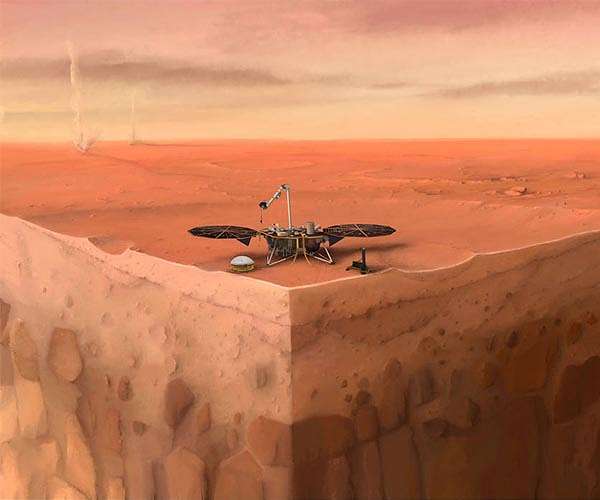
A new understanding of Mars is beginning to emerge, thanks to the first year of NASA's InSight lander mission. Findings described in a set of six papers published this week reveal a planet alive with quakes, dust devils and strange magnetic pulses. Five of the papers were published in Nature. An additional paper in Nature Geoscience details the InSight spacecraft's landing site, a shallow crater nicknamed "Homestead hollow" in a region called Elysium Planitia. InSight is the first mission dedicated to looking deep beneath the Martian surface. Among its science tools are a seismometer for detecting quakes, sensors for gauging wind and air pressure, a magnetometer, and a heat flow probe designed to take the planet's temperature. While the team continues to work on getting the probe into the Martian surface as intended, the ultra-sensitive seismometer, called the Seismic Experiment for Interior Structure (SEIS), has enabled scientists to "hear" multiple trembling events from hundreds to thousands of miles away. Seismic waves are affected by the materials they move through, giving scientists a way to study the composition of the planet's inner structure. Mars can help the team better understand how all rocky planets, including Earth, first formed.
Underground Scientists are ready for more: It took months after InSight's landing in November 2018 before they recorded the first seismic event. By the end of 2019, SEIS was detecting about two seismic signals a day, suggesting that InSight just happened to touch down at a particularly quiet time. Scientists still have their fingers crossed for "the Big One." Mars doesn't have tectonic plates like Earth, but it does have volcanically active regions that can cause rumbles. A pair of quakes was strongly linked to one such region, Cerberus Fossae, where scientists see boulders that may have been shaken down cliffsides. Ancient floods there carved channels nearly 800 miles (1,300 kilometers) long. Lava flows then seeped into those channels within the past 10 million years - the blink of an eye in geologic time. Some of these young lava flows show signs of having been fractured by quakes less than 2 million years ago. "It's just about the youngest tectonic feature on the planet," said planetary geologist Matt Golombek of JPL. "The fact that we're seeing evidence of shaking in this region isn't a surprise, but it's very cool."
At the Surface The magnetometer has found that the signals at Homestead hollow are 10 times stronger than what was predicted based on data from orbiting spacecraft that study the area. The measurements of these orbiters are averaged over a couple of hundred miles, whereas InSight's measurements are more local. Because most surface rocks at InSight's location are too young to have been magnetized by the planet's former field, "this magnetism must be coming from ancient rocks underground," said Catherine Johnson, a planetary scientist at the University of British Columbia and the Planetary Science Institute. "We're combining these data with what we know from seismology and geology to understand the magnetized layers below InSight. How strong or deep would they have to be for us to detect this field?" In addition, scientists are intrigued by how these signals change over time. The measurements vary by day and night; they also tend to pulse around midnight. Theories are still being formed as to what causes such changes, but one possibility is that they're related to the solar wind interacting with the Martian atmosphere
In the Wind Despite all that activity and frequent imaging, InSight's cameras have yet to see dust devils. But SEIS can feel these whirlwinds pulling on the surface like a giant vacuum cleaner. "Whirlwinds are perfect for subsurface seismic exploration," said Philippe Lognonne of Institut de Physique du Globe de Paris (IPGP), principal investigator of SEIS.
Still to Come: The Core This first year of data is just a start. Watching over a full Martian year (two Earth years) will give scientists a much better idea of the size and speed of the planet's wobble.
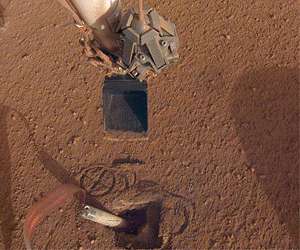
Mars InSight Lander to push on top of the 'Mole' Pasadena CA (JPL) Feb 24, 2020 After nearly a year of trying to dig into the Martian surface, the heat probe belonging to NASA's InSight lander is about to get a push. The mission team plans to command the scoop on InSight's robotic arm to press down on the "mole," the mini pile driver designed to hammer itself as much as 16 feet (5 meters) down. They hope that pushing down on the mole's top, also called the back cap, will keep it from backing out of its hole on Mars, as it did twice in recent months after nearly burying itself. ... read more
|
|||||||||||||
| The content herein, unless otherwise known to be public domain, are Copyright 1995-2026 - SpaceDaily. All websites are published in Australia and are solely subject to Australian law and governed by Fair Use principals for news reporting and research purposes. By using our websites you consent to cookie based advertising. If you do not agree with this then you must stop using the websites from May 25, 2018. Privacy Statement. Additional information can be found here at About Us. |

 del.icio.us
 Digg
Digg Reddit
 Google






