| . |  |
. |
| . | |
. |


 by Staff Writers Paris (ESA) Aug 03, 2020
European scientists will help select rocks and soil from Mars in the search for life on our planetary neighbour. Five European researchers are part of NASA's Mars 2020 science team to select the most promising martian samples bound for Earth. The mission to Mars launched last week for its seven-month journey to the Red Planet. Once there, the team will guide the Perseverance rover as it hunts for evidence of ancient microbial life. The group is made up of researchers from Belgium, France, Sweden and the UK. "These top scientists from across Europe are experts on how to collect, analyse and read the history of the rocks under our feet. Now they will also have to anticipate the needs and challenges of working with martian samples returned to laboratories back on Earth," says ESA's Mars Sample Return acting programme scientist Gerhard Kminek. For the next three years, the team will be at the core of a wider NASA team. Mark Sephton, Professor of organic geochemistry at Imperial College London in the UK, sees it as "a fantastic opportunity to have some of the finest minds in the world come together to solve one of the biggest questions in the Solar System: was there life on Mars?"
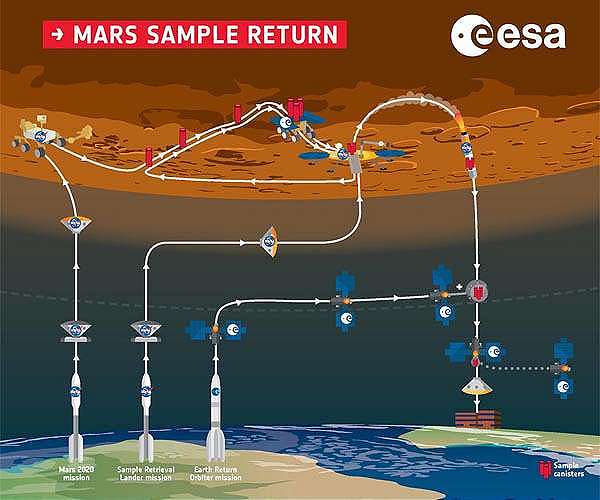
Bring it back The area contains sediments of an ancient river delta, where evidence of past life could be preserved if it ever existed on the planet. Once the Perseverance rover retrieves samples of rock and soil from Mars, it will seal them in canisters and drop them on the surface to be collected by a future retrieval mission. "The Mars 2020 mission is the first step for the ultimate martian challenge: the Mars Sample Return campaign. NASA and ESA aim to deliver the material from the martian surface to Earth by 2031," adds Gerhard. To bring Mars samples to Earth, three carefully timed missions are required. NASA will deliver the ESA Sample Fetch Rover to the vicinity of the Mars 2020 landing site. This European rover will autonomously track down and collect up to 36 sample tubes deposited by Perseverance, and take them to NASA's Mars Ascent vehicle.
Better together "I hope that, as a group of scientists with diverse expertise, we will help maximise the quality, depth and breadth of research possible with the returned samples," says palaeontologist Keyron Hickman-Lewis, who has closely worked with ESA's ExoMars rover team.
No place like Mars Finding traces of life "would represent an incredible discovery and a be a gamechanger for our views on how organisms emerge," says cosmochemist Frederic Moynier. There is no place quite like Mars to find out whether the conditions for supporting life ever existed beyond Earth. "The Red Planet is the perfect laboratory to check as the environment has dramatically changed over time," says Vinciane Debaille , geochemist at the Universite Libre de Bruxelles, in Belgium. Sandra has little doubt, "there will be surprises when we land on Mars". She and her new team cannot wait to receive the first data.
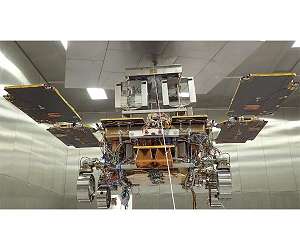
ESA tunes up Mars rover for challenges ahead Paris (ESA) Jul 23, 2020 As Mars exploration prepares for a rebirth, a European rover tunes up its gear for the challenges ahead. Tomorrow, 23 July, ESA and dozens of industrial partners will assess the readiness of the ExoMars robotic explorer, named Rosalind Franklin, for a trip to the Red Planet in 2022. The European rover will drill down to two metres into the martian surface to sample the soil, analyse its composition and search for evidence of life buried underground. The rover successfully proved that it is f ... read more
|
|||||||||||||
| The content herein, unless otherwise known to be public domain, are Copyright 1995-2026 - SpaceDaily. All websites are published in Australia and are solely subject to Australian law and governed by Fair Use principals for news reporting and research purposes. By using our websites you consent to cookie based advertising. If you do not agree with this then you must stop using the websites from May 25, 2018. Privacy Statement. Additional information can be found here at About Us. |

 del.icio.us
 Digg
Digg Reddit
 Google






