| . |  |
. |
| . | |
. |


 by Staff Writers Pasadena CA (JPL) Jul 01, 2020
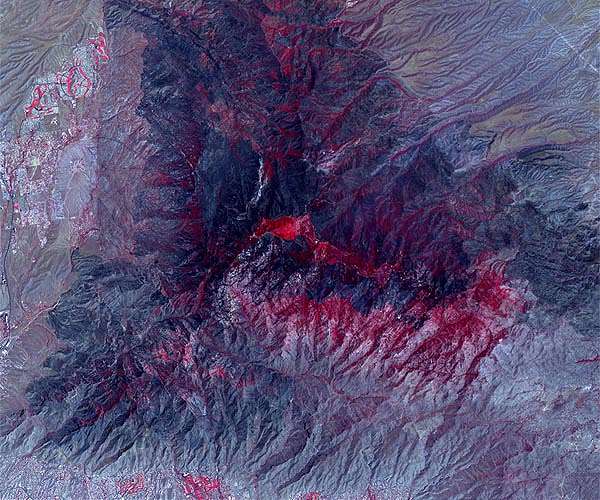
On the night of June 5, a lightning strike started the Bighorn Fire in the Santa Catalina Mountains north of Tucson, Arizona. Extremely dry vegetation and windy conditions caused the fire to spread quickly. By June 30, the multi-agency incident information system, InciWeb, reported that it had ballooned to more than 114,000 acres and that it was about 45% contained. NASA's Advanced Spaceborne Thermal Emission and Reflection Radiometer (ASTER) instrument aboard the Terra satellite imaged some of the burned area on June 29. In this image, vegetation is shown in red and burned areas appear dark gray. It covers an area 20 by 30 miles (33 by 48 kilometers). Efforts to contain the fire continue with 21 hand crews, 10 helicopters and dozens of fire engines deployed to the area. Smoke impacts to surrounding communities are being carefully monitored. With its 14 spectral bands from the visible to the thermal infrared wavelength region and its high spatial resolution of about 50 to 300 feet (15 to 91 meters), ASTER images Earth to map and monitor the changing surface of our planet. It is one of five Earth-observing instruments launched Dec. 18, 1999, on Terra. The instrument was built by Japan's Ministry of Economy, Trade and Industry. A joint U.S./Japan science team is responsible for validation and calibration of the instrument and data products. The broad spectral coverage and high spectral resolution of ASTER provides scientists in numerous disciplines with critical information for surface mapping and monitoring of dynamic conditions and temporal change. Example applications are monitoring glacial advances and retreats; monitoring potentially active volcanoes; identifying crop stress; determining cloud morphology and physical properties; wetlands evaluation; thermal pollution monitoring; coral reef degradation; surface temperature mapping of soils and geology; and measuring surface heat balance.
Self-powered alarm fights forest fires, monitors environment East Lansing MI (SPX) Jun 26, 2020 Smokey the Bear says that only you can prevent wildfires, but what if Smokey had a high-tech backup? In a new study, a team of Michigan State University scientists designed and fabricated a remote forest fire detection and alarm system powered by nothing but the movement of the trees in the wind. As detailed in the journal Advanced Functional Materials, the device, known as MC-TENG - short for multilayered cylindrical triboelectric nanogenerator (TENG) - generates electrical power by harvesting en ... read more
|
|||||||||||||
| The content herein, unless otherwise known to be public domain, are Copyright 1995-2026 - SpaceDaily. All websites are published in Australia and are solely subject to Australian law and governed by Fair Use principals for news reporting and research purposes. By using our websites you consent to cookie based advertising. If you do not agree with this then you must stop using the websites from May 25, 2018. Privacy Statement. Additional information can be found here at About Us. |

 del.icio.us
 Digg
Digg Reddit
 Google







