24/7 Space News
SPACEWAR
AFRL partners with NASA in cubesat navigation, communication mission
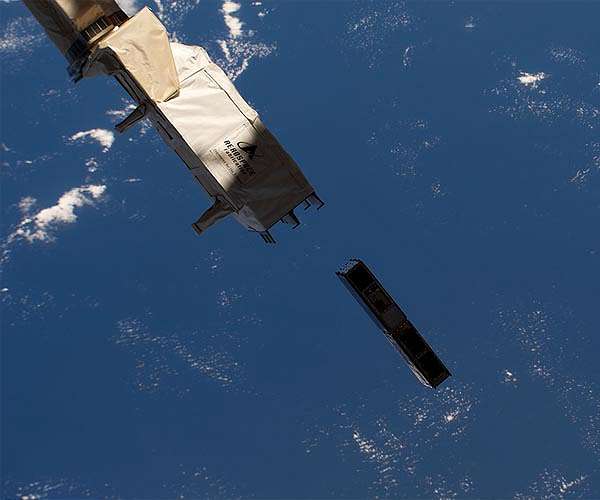
AFRL anticipates GRIDS will be in orbit for six months. A second GRIDS deployment, also in collaboration with NASA, is planned for 2024.
AFRL partners with NASA in cubesat navigation, communication mission
by Jeanne Dailey for AFRL NEWS
Kirtland AFB NM (SPX) Feb 03, 2023
The Air Force Research Laboratory's, or AFRL, newest sensor experiment deployed from the International Space Station Dec. 29, 2022, hosted on NASA's six-unit cube satellite named petitSat, or Plasma Enhancements in the Ionosphere-Thermosphere Satellite.

The CubeSat's mission is to study a layer in Earth's upper atmosphere known as the ionosphere to provide insight into space weather disturbances and their impact on navigation and communication systems.

AFRL's sensor, developed at the enterprise's Space Vehicles Directorate, is named Gridded Retarding Ion Drift Sensor, or GRIDS, and is one of two main sensors flying on the mission. The GRIDS sensor is a low size, weight and power sensor built in-house over the past two years that will measure various ions in the ionosphere.

"This experiment will increase our fundamental understanding of how the ionosphere works and allow us to determine operational models and strategies to increase the resiliency of the Space Force's space-based assets," said Ryan Davidson, AFRL senior research physicist and program manager for the experiment.

"The GRIDS sensor is designed to measure how much plasma is present in the atmosphere and in what direction it is moving. This should allow us to detect the presence of plasma bubbles and globs and give us information into how they are formed."

Davidson explained the Earth's upper atmosphere is where most low Earth-orbiting satellites reside and that their orbits are strongly affected by sudden density changes created by space weather.

The accumulation of plasma in the form of bubbles and globs affects radio propagation of satellite-based navigation and communications passing in the vicinity of these plasma formations, which interfere with GPS and radar signals.

"In this experiment, AFRL hopes to determine the formation mechanism of plasma perturbations and use that information to feed predictive ionospheric models and make them more accurate to increase satellite navigation and communication, thereby increasing the protection of vital assets such as the Global Positioning System," Davidson said.

AFRL anticipates GRIDS will be in orbit for six months. A second GRIDS deployment, also in collaboration with NASA, is planned for 2024.

Related Links
Air Force Research Laboratory
Military Space News at SpaceWar.com

Subscribe Free To Our Daily Newsletters
Tweet

RELATED CONTENT
SPACEWAR
VCSO inspires next generation of Guardians at Virginia Tech
Blacksburg VA (SPX) Jan 27, 2023
More than 150 cadets arrived at Virginia Tech's Goodwin Hall January 20-22, 2023, for Detachment 857's Space Training and Readiness Squadron (STARS) Align event focused on professional development. Cadets traveled from 27 detachments, each with their own background and experience in the Air Force Reserve Officer Training Corps. STARS Align was organized by cadets from Detachment 875 to build connections between future Guardians and Airmen. Simultaneously, the team aimed to promote greater understa ... read more

SPACEWAR
Design a spacesuit for ESA

NASA announces finalists in challenge to design future astronaut food

NASA's Aerospace Safety Advisory Panel releases 2022 Annual Report

NASA names first person of Hispanic heritage as chief astronaut

SPACEWAR
Launches of Busek Thrusters push OneWeb constellation towards completion

Poland's SatRev signs on for future Virgin Orbit flights

SpaceX launches Hispasat's Amazonas Nexus communication satellite

First step toward predicting lifespan of electric space propulsion systems

SPACEWAR
Mars Helicopter at Three Forks

Searching for a Drill Site Near Encanto: Sols 3735-3736

Enchanting Encanto Calls: Sols 3732-3734

The faults and valleys of a Martian volcanic highland plateau

SPACEWAR
China's Deep Space Exploration Lab eyes top global talents

Chinese astronauts send Spring Festival greetings from space station

China to launch 200-plus spacecraft in 2023

China's space industry hits new heights

SPACEWAR
OneWeb and Kazakhstan National Railways to work together

ATLAS works with AWS to advance federated network and expand ground station coverage

Sidus Space closes public offering

Lockheed Martin's first LM 400 Multi-Mission Spacecraft completed

SPACEWAR
AWE completes space environment tests

Momentus Vigoride-5 Status Update #2

Automating the math for decision-making under uncertainty

Understanding laser accelerated electron radiation through terahertz emissions

SPACEWAR
Researchers focus AI on finding exoplanets

A nearby potentially habitable Earth-mass exoplanet

Two nearby exoplanets might be habitable

Will machine learning help us find extraterrestrial life

SPACEWAR
SwRI models explain canyons on Pluto moon

NASA's Juno Team assessing camera after 48th flyby of Jupiter

Webb spies Chariklo ring system with high-precision technique

Europe's JUICE spacecraft ready to explore Jupiter's icy moons


The content herein, unless otherwise known to be public domain, are Copyright 1995-2026 - SpaceDaily.com. All websites are published in Australia and are solely subject to Australian law and governed by Fair Use principals for news reporting and research purposes. AFP, UPI and IANS news wire stories are copyright Agence France-Presse, United Press International and Indo-Asia News Service. ESA news reports are copyright European Space Agency. All NASA sourced material is public domain. Additional copyrights may apply in whole or part to other bona fide parties. All articles labeled "by Staff Writers" include reports supplied to Space Media Network by industry news wires, PR agencies, corporate press officers and the like. Such articles are individually curated and edited by Space Media Network staff on the basis of the report's information value to our industry and professional readership. Advertising does not imply endorsement, agreement or approval of any opinions, statements or information provided by Space Media Network on any Web page published or hosted by Space Media Network. General Data Protection Regulation (GDPR) Statement Our advertisers use various cookies and the like to deliver the best ad banner available at one time. All network advertising suppliers have GDPR policies (Legitimate Interest) that conform with EU regulations for data collection. By using our websites you consent to cookie based advertising. If you do not agree with this then you must stop using the websites from May 25, 2018. Privacy Statement. Additional information can be found here at About Us.
Subscribe Free To Our Daily Newsletters