| . |  |
. |
| . | |
. |


 by Staff Writers Legazpi, Philippines (AFP) Jan 29, 2018
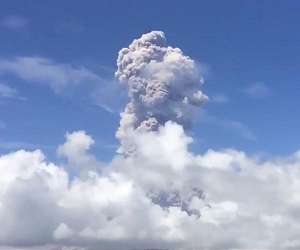
The number of Filipinos fleeing from the erupting Mayon volcano to safe zones has swelled to nearly 90,000, officials said Monday, worsening a sanitation crisis in the already stretched relief camps. President Rodrigo Duterte flew to the central city of Legazpi on Monday to assess the disaster zone, some two weeks after the country's most active volcano began belching spectacular but potentially lethal ash columns, lava and rocks. Authorities have thrown a nine kilometre (5.6 mile) no-go zone around the mountain with the vast majority of those living in its shadow now safely outside that radius. But sanitary conditions in the safe-zones are far from ideal. Al Francis Bichara, the governor of Albay province, said authorities expect the evacuees will need to stay at the camps for at least a month. But he warned limited local government resources were being stretched, citing the lack of toilets at the shelters, where he said an average of 200 people now took turns using one. "We lack 1,222 toilets," he said, adding the ideal was one toilet for every 50 evacuee (1,800 total). After being briefed by officials Duterte said he was worried about the lack of toilets. "One worry really is the sanitation," he told the officials, adding his government would try to send as many portable cabins as possible in the coming days. Officials said they were confident the no-go zone radius was large enough to keep people safe from even a large explosive eruption. "Even if that happens we think the people are already safe," state volcanology institute chief Renato Solidum said. He stressed the eruption was not over despite a relatively quiet weekend, estimating some "50 million cubic metres" more debris had the potential to be ejected from the crater in the coming days and weeks. If cooling lava blocks the crater gas pressure would build up and cause the magma inside to explode, producing eruption columns far taller than the five-kilometres-tall clouds seen in previous days, he said. Officials have also told AFP farmers are also going back to the danger zone to tend to their crops and livestock, putting them within range of white-hot volcanic debris shooting down Mayon's flanks at great speed. Solidum said local authorities were also making sure loose volcanic debris deposited on Mayon's flanks would not threaten lives and properties should they be dislodged by heavy rain and turn into mudslides. The 2,460-metre (8,070-foot) Mayon, a perfect cone rising 330 kilometres southeast of Manila, is the country's most active volcano -- now on its 52nd eruption in four centuries. It killed 1,200 people when it buried the town of Cagsawa in 1814.
 Philippines plans forced evacuations from erupting volcano
Legazpi, Philippines (AFP) Jan 25, 2018 Philippine authorities said Thursday they will remove by force people who have refused to leave a no-go zone around an erupting volcano, as they seek to avoid casualties after tens of thousands of others fled to safety. There have been no deaths in the 10 days since Mount Mayon began belching flaming lava, superheated rocks and ash, causing 75,450 residents to flee surrounding farms and comm ... read more Related Links Bringing Order To A World Of Disasters When the Earth Quakes A world of storm and tempest

|
|||||||||||||
| The content herein, unless otherwise known to be public domain, are Copyright 1995-2026 - SpaceDaily. All websites are published in Australia and are solely subject to Australian law and governed by Fair Use principals for news reporting and research purposes. By using our websites you consent to cookie based advertising. If you do not agree with this then you must stop using the websites from May 25, 2018. Privacy Statement. Additional information can be found here at About Us. |

 del.icio.us
 Digg
Digg Reddit
 Google






