|
 |
 |
 |
 |
 |
 |
 |
 |
 |

| . |  |
. |
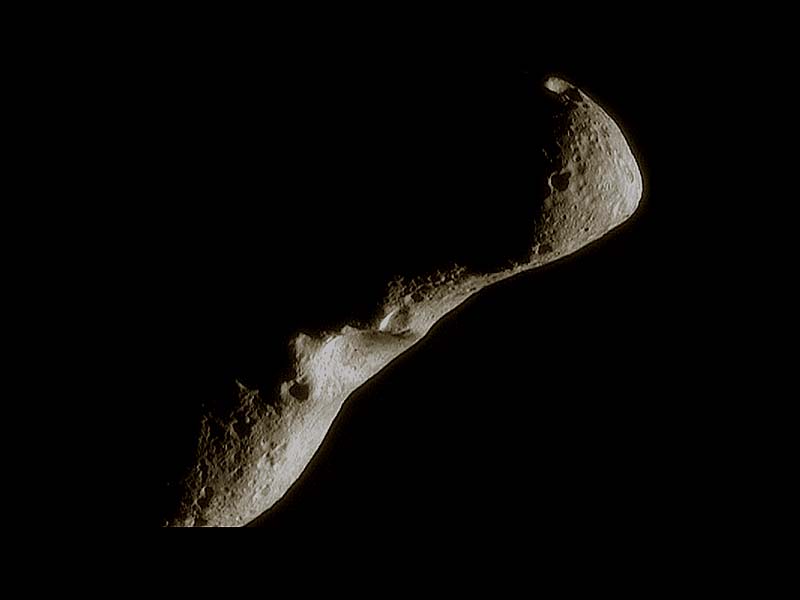 A Stratified Eros
Laurel - February 23, 2000 - The images we have seen to date provide a tantalizing glimpse of what lies in store for us as NEAR begins its year-long study of Eros. From the images-of-the-day for February 14-17, we have many hints of an underlying global fabric - the nearly parallel markings, the chains of small craters or pits, the grooves - but our exploration has barely begun. Our image resolution will improve by more than ten times over the best we have achieved to date, and we have yet to bring several of our instruments to bear on the asteroid. One interpretation of the global fabric is that it is the surface manifestation of stratigraphy - that is, layered structure - which was produced while Eros was part of a much larger parent body that was disrupted long ago by a monstrous collision. In other words, the global fabric may be a signature of ancient geologic activity (for example, volcanism) on the parent body of Eros. The size of this putative parent body, and the time at which it would have disrupted, are not known, and all we can say is that it must have been much larger than the present maximum diameter of Eros (33 km). It may or may not have been larger than the present-day 500-km asteroid Vesta. Another interpretation is that the global fabric results from large-scale fractures within Eros caused by a giant impact, which may have occurred on the parent body of Eros (so we would not necessarily see the huge crater on present day Eros). We will learn much more from higher resolution images, spatially resolved spectral maps, composition data, and altimetry later in the mission. Another important early result from the Eros images is reported in the image-of-the-day for February 21, which shows that the surface of Eros is old like the surface of Ida. This graphic summarizes initial results of crater counts, which are made using data like that in the image-of-the-day February 16A. The February 21 plot gives the number of craters of a given size range found per unit area of Eros. Geometric saturation means that craters of a given size basically cover the surface. Of course, much more will be done with crater counting as higher resolution images are obtained. However, it is already clear that Eros does not have a high density of giant craters as found on Mathilde, where the giant craters approach geometric saturation (by giant craters we mean those that have a diameter close to or bigger than the radius of Mathilde itself). It is also clear that Eros does not have a paucity of craters, especially large ones, as does Gaspra. The NEAR data show that Eros has an older surface than Gaspra - Gaspra is less heavily cratered because it has not been exposed to bombardment as long.
However, since we are still uncertain about collision rates in the asteroid belt at present and in the distant past, we cannot actually state an age for either asteroid.
|
|
| ||||||||
| The content herein, unless otherwise known to be public domain, are Copyright 1995-2016 - Space Media Network. All websites are published in Australia and are solely subject to Australian law and governed by Fair Use principals for news reporting and research purposes. AFP, UPI and IANS news wire stories are copyright Agence France-Presse, United Press International and Indo-Asia News Service. ESA news reports are copyright European Space Agency. All NASA sourced material is public domain. Additional copyrights may apply in whole or part to other bona fide parties. Advertising does not imply endorsement, agreement or approval of any opinions, statements or information provided by Space Media Network on any Web page published or hosted by Space Media Network. Privacy Statement All images and articles appearing on Space Media Network have been edited or digitally altered in some way. Any requests to remove copyright material will be acted upon in a timely and appropriate manner. Any attempt to extort money from Space Media Network will be ignored and reported to Australian Law Enforcement Agencies as a potential case of financial fraud involving the use of a telephonic carriage device or postal service. |