
 |
 |
 |
 |
 |
 |
 |
 |
 |
 |

| . |  |
. |
First Asteroid Rendezvous Days Away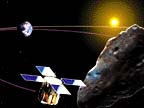 Laurel - January 17, 2000 - With long range observations already underway, mission controllers at John Hopkins have begun 24 hour operations as they bring a distant spacecraft for the first time into orbit about an asteroid.
Following a failed attempt to rendezvous about Eros in Decmebr 1998, the NEAR team is leaving nothing to chance. "The spacecraft is doing a lot of work, and we need to make sure things are happening the way we expect," says Mark Holdridge, NEAR mission operations manager. "This is the stretch drive as we prepare for the orbit insertion." The 24-hour operations mark a milestone in the mission to Eros, which intensifies with rendezvous maneuvers on Feb. 2 and the actual orbit insertion on Feb. 14. NEAR is 29,800 miles (48,000 kilometers) from Eros, but its instruments are already collecting valuable navigation data and detailed scientific information on the large space rock. From Jan. 11, the NEAR began downloading this information daily through NASA's Deep Space Network. The raw data will be available on the NEAR Science Data Center Web site a week after it's collected. The observations will fix NEAR's imaging instruments on their rotating, 21-mile-long target. The low-resolution images won't offer much detail - NEAR will be about 29,800 miles (47,973 kilometers) from Eros - but they will help the mission team navigate the spacecraft and prepare for the Feb. 14 encounter and yearlong study of the asteroid. Upcoming Spacecraft Activities: The following are operationally significant activities planned through Eros orbit insertion. Please consult the NEAR Flight Timeline for more details regarding upcoming activities.
Jan 14 Begin regular Eros OpNavs
|
|
| ||||||||
| The content herein, unless otherwise known to be public domain, are Copyright 1995-2016 - Space Media Network. All websites are published in Australia and are solely subject to Australian law and governed by Fair Use principals for news reporting and research purposes. AFP, UPI and IANS news wire stories are copyright Agence France-Presse, United Press International and Indo-Asia News Service. ESA news reports are copyright European Space Agency. All NASA sourced material is public domain. Additional copyrights may apply in whole or part to other bona fide parties. Advertising does not imply endorsement, agreement or approval of any opinions, statements or information provided by Space Media Network on any Web page published or hosted by Space Media Network. Privacy Statement All images and articles appearing on Space Media Network have been edited or digitally altered in some way. Any requests to remove copyright material will be acted upon in a timely and appropriate manner. Any attempt to extort money from Space Media Network will be ignored and reported to Australian Law Enforcement Agencies as a potential case of financial fraud involving the use of a telephonic carriage device or postal service. |
 Laurel - August 12, 1999 - At 1 p.m., today, a 2-minute hydrazine engine burn put the NASA Discovery Program's NEAR spacecraft, on a direct path to intercept asteroid 433 Eros early next year. Commands from the Near Earth Asteroid Rendezvous Mission Operations Center at The Johns Hopkins University Applied Physics Laboratory, Laurel, Md., were carried out flawlessly by the spacecraft.