| . |  |
. |
| . | |
. |


 by Staff Writers New York (AFP) Nov 6, 2019
An Uber self-driving car that struck and killed a woman last year in Arizona failed to recognize her as a pedestrian because she was jaywalking, US transport regulators said Tuesday. The woman had been crossing the street "at a location without a crosswalk; the system design did not include a consideration for jaywalking pedestrians," the US National Transportation Safety Board (NTSB) said in a statement. In a preliminary report, the NTSB had already determined that the car's software spotted the 49-year-old woman nearly six seconds before the vehicle hit her, as she walked across the street at night with her bicycle in Tempe, a suburb of Phoenix. According to the latest report, which was issued ahead of a November 19 hearing to officially determine the accident's cause, the system at no time "classified her as a pedestrian" but rather, considered her an object. When the software determined that a collision was imminent approximately 1.2 seconds before impact, it suppressed any "extreme braking or steering actions" to reduce the potential for erratic vehicle behavior. It did, however, produce "an auditory alert to the vehicle operator as it initiated a plan for the vehicle slowdown." Following the March 2018 accident, Uber suspended its autonomous driving testing in all locations in the United States but resumed the program several months later. The company has assured the NTSB that new technology in the cars will correctly recognize pedestrians in similar situations and trigger braking more than four seconds before impact. According to the report, 37 crashes involving Uber automatic test vehicles operating in autonomous mode occurred between September 2016 and March 2018, excluding the Arizona crash. jum/bfm/wd
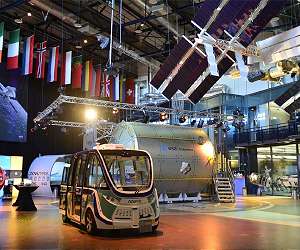
Driving into the future Noordwijk, Netherlands (ESA) Nov 01, 2019 A highly autonomous self-driving shuttle has entered service at ESA's technical heart. Its official inauguration took place on Tuesday, when it was assigned a suitably spacey name - 'Orbiter' - chosen through an employee competition. The Agency's ESTEC establishment in Noordwijk, the Netherlands, is being used as a testbed for the automated shuttle, to assess its viability as a 'last mile' solution for public transport. ESTEC was selected because it is a controlled private environment but wi ... read more
|
|||||||||||||
| The content herein, unless otherwise known to be public domain, are Copyright 1995-2026 - SpaceDaily. All websites are published in Australia and are solely subject to Australian law and governed by Fair Use principals for news reporting and research purposes. By using our websites you consent to cookie based advertising. If you do not agree with this then you must stop using the websites from May 25, 2018. Privacy Statement. Additional information can be found here at About Us. |


 del.icio.us
 Digg
Digg Reddit
 Google







