| . |  |
. |
| . | |
. |


 by Staff Writers Tucson AZ (SPX) Oct 09, 2018
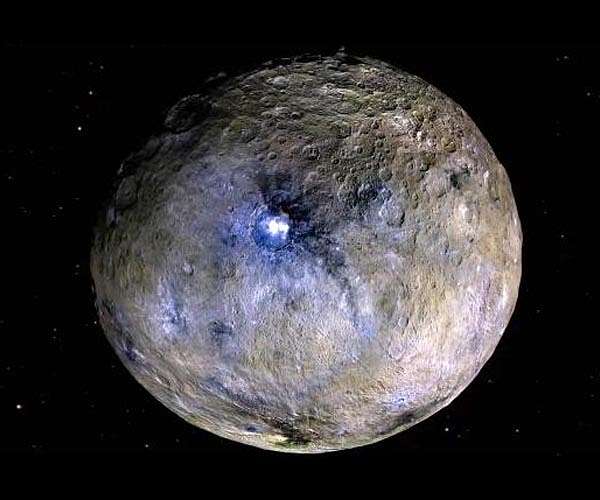
Dwarf planet Ceres experienced an indirect polar reorientation of approximately 36 degrees, a new paper by Planetary Science Institute Senior Scientist Pasquale Tricarico says. Tricarico's paper "True Polar Wander of Ceres Due to Heterogeneous Crustal Density" appears in Nature Geoscience. Using data from NASA's Dawn mission, Tricarico determined the magnitude of the reorientation with three independent and corroborating lines of evidence. Global gravity inversion, from a paper Tricarico published in 2013, helped determine the density variations of Ceres, especially in the crust. This is what was used to find the equatorial density anomaly. Statistical analysis of topography was used for ridge analysis and the paleo-pole. And for matching the crustal fractures, a well-proven method by Matsuyama and Nimmo was used. "The most surprising aspect of this paper is to me the observation that the pole of Ceres must have followed an indirect path to its current pole. A multi-step reorientation could mean that the equatorial density anomaly was still evolving during the reorientation, and this could be because the crust and mantle were weakly rotationally coupled, allowing the crust to start reorienting while the mantle would lag behind," Tricarico said. "If crust and mantle are allowed to shift with respect to one another, that could point to a layer of reduced friction between crust and mantle, and one of the possible mechanisms to reduce friction could be an ancient water ocean beneath the crust." The Dawn mission has orbited Ceres for more than three years, gathering very detailed observations and allowing the construction of detailed geophysical models. These detailed models can then be adapted for comparison to other icy bodies, Tricarico said. One such example is the parallel between the well-known equatorial ridge of Iapetus, the moon of Saturn, and the remnants of the paleo-equatorial ridge of Ceres.
Research Report: "True Polar Wander of Ceres Due to Heterogeneous Crustal Density," P. Tricarico, 2018 Oct. 8, Nature Geoscience
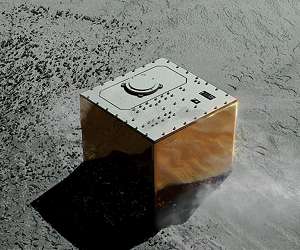
MASCOT lands safely on Asteroid Ryugu MASCOT on board Hayabusa2 Berlin, Germany (SPX) Oct 04, 2018 The near-Earth asteroid Ryugu, located approximately 300 million kilometres from Earth, has a new inhabitant: On 3 October 2018, the Mobile Asteroid Surface Scout (MASCOT) landed on the asteroid and began to work. The lander successfully separated from the Japanese Hayabusa2 space probe at 03:58 CEST. The 16 hours in which the lander will conduct measurements on the asteroid's surface have begun for the international team of engineers and scientists. The day bef ... read more
|
|||||||||||||
| The content herein, unless otherwise known to be public domain, are Copyright 1995-2026 - SpaceDaily. All websites are published in Australia and are solely subject to Australian law and governed by Fair Use principals for news reporting and research purposes. By using our websites you consent to cookie based advertising. If you do not agree with this then you must stop using the websites from May 25, 2018. Privacy Statement. Additional information can be found here at About Us. |

 del.icio.us
 Digg
Digg Reddit
 Google







