|
 |
 |
 |
 |
 |
 |
 |
 |
 |

| . |  |
. |
NASA's Comet Impactor On Course For Comet Tempel 1
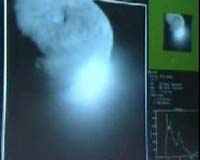
Pasadena CA (AFP) July 3, 2005 The first-ever projectile shot at a passing comet was late Sunday just hours away from giving scientists a glimpse into the celestial body, a NASA official said. NASA scientists fired a projectile from the "Deep Impact" mother ship toward the comet Tempel 1 hoping to penetrate its surface and gain new clues about the origins of the solar system. The cosmic hit could produce a brilliant light show visible from Earth with binoculars -- or could yield a poof of dust, if the comet proves to be just a loose pile of rubble, as some experts suspect. Rick Grammier, project manager of the Deep Impact operation, described the probe as "a well-behaved spacecraft." The projectile fired from the Deep Impact mothership is set to collide with the Tempel 1 -- a rock half the size of the island of Manhattan hurtling through space at some 37,100 kilometers (23,000 miles) per hour -- at 0552 GMT Monday. "As far as we know, impact time hasn't changed," said Launch Activity leader Jennifer Marie Rocca, who described her team as "very, very excited." Although there are faint similarities with the 1998 movie "Deep Impact," in which a US spaceship attacks an errant comet with nuclear weapons to ward off its collision with Earth, the projectile hurtling toward comet Tempel 1 was launched purely in pursuit of scientific goals, space officials said. The cosmic sniper shot will see both the target and the projectile move at least 20 times faster than bullets. The projectile, the size of an oil drum, was fired at 0607 GMT Sunday by the US spacecraft that had undertaken a 172-day, 431-million-kilometer (268-million-mile) journey to get close to the comet. Twelve minutes after the release, a camera-equipped probe peeled off from the projectile and set on a separate path. It will get within 500 kilometers (310 miles) of Tempel 1 shortly after the copper-laden impactor slams into it. "We're going to get a tremendous amount of data," said University of Maryland professor of astronomy Michael A'Hearn, the mission's lead investigator. The probe will likely gouge a large crater on the surface of the comet, sending up a cloud of ice, dust and debris that researchers hope will offer valuable information. The fly-by probe will have about 13 minutes to take images of the collision and the resulting cloud before it is swallowed by what scientists believe could be a blizzard of particles from the comet nucleus. Images will also be beamed back to the mother spaceship by the impactor in the final minutes of its life, allowing scientists a glimpse into the cloud of gases and dust that surrounds the comet. In addition to the four data collectors it is equipped with, it will be backed up by the US Hubble and Spitzer space telescopes, Chandra X-ray observatory and European spacecraft. Deep Impact will communicate with Earth via 34-meter high antennae of NASA's Deep Space Network where the data it sends will be scrutinized by the 250-strong scientist and engineer team. Images of the 333 million dollar experimental collision will also be captured by telescopes installed in northern Chile, the European Southern Observatory (ESO) said. NASA has likened the impact to be made by its projectile to that of a mosquito hitting a Boeing 747 airplane. Comets circling the sun, which are numbered in billions, are believed to be leftovers from a massive cloud of gas and dust that condensed to form the sun and planets about 4.6 billion years ago. Related Links SpaceDaily Search SpaceDaily Subscribe To SpaceDaily Express
 Comet Impactor Hits Tempel 1
 Pasadena CA (AFP) July 3, 2005
A US space projectile crashed head-on into a comet hurtling through the solar system Monday in an unprecedented feat of technology that scientists hope will help reveal the secrets of the Universe. |
|
|

| The content herein, unless otherwise known to be public domain, are Copyright 1995-2006 - SpaceDaily.AFP and UPI Wire Stories are copyright Agence France-Presse and United Press International. ESA PortalReports are copyright European Space Agency. All NASA sourced material is public domain. Additionalcopyrights may apply in whole or part to other bona fide parties. Advertising does not imply endorsement,agreement or approval of any opinions, statements or information provided by SpaceDaily on any Web page published or hosted by SpaceDaily. Privacy Statement |