|
 |
 |
 |
 |
 |
 |
 |
 |
 |

| . |  |
. |
Comet Impactor Hits Tempel 1
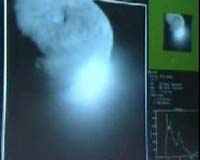
Pasadena CA (AFP) July 3, 2005 A US space projectile crashed head-on into a comet hurtling through the solar system Monday in an unprecedented feat of technology that scientists hope will help reveal the secrets of the Universe. The probe rammed the heart of the Tempel 1 comet exactly as planned at 0552 GMT, 133 million kilometers (83 million miles) from Earth. "That's awesome! That's awesome!" US flight control officials shouted after the impact was confirmed. "We hit just exactly where we wanted to." A picture sent to Earth by a fly-by probe showed a bright flash of light as the projectile collided with the comet, which is traveling through the solar system at approximately 37,100 kilometers (23,000 miles) per hour and is equal in size to half of Manhattan Island. The copper-laden impactor was beaming back high-resolution pictures of the comet until just a few seconds before the collision. They showed craters, ridges and presumed glaciers on the potato-shaped comet that was discovered in 1867 and named Tempel 1. "We have put a new trail for other people to follow," said Charles Elachi, director of the Jet Propulsion Laboratory, a division of the National Aeronautics and Space Administration that was a key partner in the experiment. The reason scientists are so excited is that comets circling the Sun, which are numbered in billions, are seen as leftovers from a massive cloud of gas and dust that condensed to form the Sun and planets about 4.6 billion years ago. Their geological and chemical structures could thus contain important clues to the nature of the Universe and how it was formed, including Earth. The projectile was fired from a mothership spacecraft, "Deep Impact," that was itself launched from the Kennedy Space Center in Florida in January. It undertook a 173-day, 431-million-kilometer journey to get close to Tempel 1. After launching the projectile, it then recorded data from the impact. "It's just absolutely stunning," NASA Associate Administrator Al Diaz told reporters. "To be in a situation where we are here tracking a comet for this period of time and then precisely positioning a spacecraft in a way that creates that environment that is so bright... I am speechless!" He said the success was thanks to broad cooperation between scientists and researchers inside and outside the United States. Although incoming imagery is still to be analyzed, the impact was expected to gouge a large crater on the surface of the comet, sending up a cloud of ice, dust and debris that researchers hope will offer valuable information. A separate fly-by probe took images of the resulting cloud, which scientists believe could contain particles from the comet nucleus. "We're just basically starting our work now," said Michael A'Hearn, "Deep Impact" principal investigator, "Interpreting will take a bit of a time". On Saturday, Tempel 1 belched out more ice and dust, expanding the size of the cloud around it. The outburst, the fourth in the past three weeks, was not of particular concern to National Aeronautics and Space Administration scientists, said project manager Rick Grammier. "The comet is definitely full of surprises so far and probably has a few more in store for us," he commented. Scientists insisted that although the experiment was reminiscent of the 1998 movie "Deep Impact," in which a US spaceship attacks a monster comet with nuclear weapons to ward off its collision with Earth, the real-life strike on Tempel 1 was in pursuit of exclusively scientific goals. "Comet Tempel 1 poses no threat to the Earth now or in the foreseeable future," said Don Yeomans, a mission scientist with NASA's Jet Propulsion Laboratory. Related Links SpaceDaily Search SpaceDaily Subscribe To SpaceDaily Express
 NASA's Deep Impact Spacecraft Preps for July 4 Fireworks
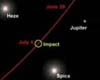 Pasadena CA (JPL) Jul 03, 2005
NASA's Deep Impact spacecraft continues to sail through its final checkout, as it hurtles toward comet Tempel 1. Impact with the comet is scheduled for 1:52 a.m. EDT, July 4 (10:52 p.m. PDT, July 3). |
|
|

| The content herein, unless otherwise known to be public domain, are Copyright 1995-2006 - SpaceDaily.AFP and UPI Wire Stories are copyright Agence France-Presse and United Press International. ESA PortalReports are copyright European Space Agency. All NASA sourced material is public domain. Additionalcopyrights may apply in whole or part to other bona fide parties. Advertising does not imply endorsement,agreement or approval of any opinions, statements or information provided by SpaceDaily on any Web page published or hosted by SpaceDaily. Privacy Statement |