|
 |
 |
 |
 |
 |
 |
 |
 |
 |

| . |  |
. |
Mozhayets Satellite Lost - Russian Commission
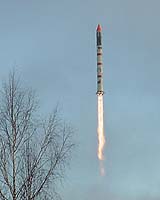
Moscow, Russia (SPX) Nov 08, 2005 The commission investigating the failure of the Mozhayets satellite to detach from the Kosmos-3M booster and make contact on October 27, 2005, said there was little hope of regaining control of the unit, reports Itar-Tass. A source at the Plesetsk cosmodrome, the launch site of the satellite noted that the inter-departmental commission continues to investigate the cause of the malfunction. "On Sunday, a commission of Space Troops and a insurance company representatives arrived at the cosmodrome," the source added. An emergency affecting Mozhayets occurred several hours after the blast-off. Under one of the versions, the satellite failed to detach from the booster due to a command flow error. Supposedly, it botched the execution of the command for blowing off by explosive bolts, which had to separate the craft from the second stage, sending it into autonomous flight. Mozhayets-5, an experimental satellite, was the main payload of the October 27 launch, intended as an interface in training satellite control at the Mozhaisky military space academy. Its other function was to assess the influence of radiation on avionics at an altitude of 700 to 800 kilometers, reports Itar-Tass. However, the booster put in orbits eight other satellites, including two China-DMC remote-probing units, developed by Britain's SSTL, and Britain's TopSat. Mesbah, one of the two Iranian satellites, was manufactured by Italy's Carlo Gavazzi Space. Sinah-1 was manufactured in Iran. SSETI Express of the European Space Agency, with a mass of 62 kilograms, was developed within the framework of a European educational project for students of ten universities. After reaching a preset orbit, it launched three ultra small pico-satellites each weighing one kilogram. The pico-satellites belong to the University of Wurzburg, Germany, the Tokyo University and the Andoya rocket range, in Norway. The two-stage booster Kosmos-3M can take payloads of up to 1,500 kilograms to 1,700-kilometer to 250-kilometer orbits. Russia has been using it since 1971. Related Links SpaceDaily Search SpaceDaily Subscribe To SpaceDaily Express
 Cutting Edge Micro-Satellite Achieves Milestones
 Kirtland AFB NM (SPX) Nov 07, 2005
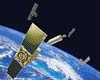
A 220-pound micro-satellite developed by the Air Force Research Laboratory's Space Vehicles Directorate here recently accomplished significant mission milestones when it rendezvoused with the upper stage of a Minotaur I launch vehicle at distances between 1.5 kilometers and 500 meters. |
|
|

| The content herein, unless otherwise known to be public domain, are Copyright 1995-2006 - SpaceDaily.AFP and UPI Wire Stories are copyright Agence France-Presse and United Press International. ESA PortalReports are copyright European Space Agency. All NASA sourced material is public domain. Additionalcopyrights may apply in whole or part to other bona fide parties. Advertising does not imply endorsement,agreement or approval of any opinions, statements or information provided by SpaceDaily on any Web page published or hosted by SpaceDaily. Privacy Statement |