|
 |
 |
 |
 |
 |
 |
 |
 |
 |

| . |  |
. |
Cutting Edge Micro-Satellite Achieves Milestones
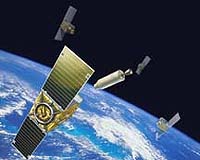
Kirtland AFB NM (SPX) Nov 07, 2005 A 220-pound micro-satellite developed by the Air Force Research Laboratory's Space Vehicles Directorate here recently accomplished significant mission milestones when it rendezvoused with the upper stage of a Minotaur I launch vehicle at distances between 1.5 kilometers and 500 meters. The Air Force has used the Experimental Satellite System-11 micro-satellite, commonly referred to as XSS-11, to investigate a variety of prospective space applications, including servicing, repair and resupply. "XSS-11 is a demonstration in space rendezvous and proximity operations," said Harold Baker, XSS-11 program manager. "The spacecraft also has an onboard rendezvous and proximity operations planner in the avionics to aid in developing autonomous operations for future concepts and missions." Launched in April 2005 from Vandenberg Air Force Base, Calif., XSS-11 has completed more than 75 natural-motion circumnavigations of the expended Minotaur I rocket body. During its projected 12- to 18-month flight, the spacecraft will conduct rendezvous and proximity maneuvers with several U.S.-owned dead or inactive space objects near its orbit. It will also demonstrate more autonomy as the project continues. "The micro-satellite is performing better than expected," Mr. Baker said. "Fuel consumption and efficiency is good, and we expect to be operational for another year. In addition, we have had no significant technical glitches and no major anomalies." Managing and monitoring the micro-satellite's progress has been the focus of the flight control team composed of people from both the Space Vehicles Directorate and the Space and Missile Systems Center's Detachment 12, also located here. Staffing, however, has been reduced by 50 percent due to the spacecraft's flawless performance, and officials said another decrease is expected in the future as the micro-satellite's demonstration in autonomy advances. With a projected cost of $82 million, XSS-11 program managers have planned an aggressive, event-driven flight which could ultimately enhance Air Force Space Command's prospective missions of space servicing and maintenance and space support. In addition, due to its innovative autonomous flight, officials said the XSS-11 mission may reduce the number of people and the amount of equipment needed to operate future space missions. "The micro-satellite will remain in a systems functional test for the next month or two, as we are still checking out the spacecraft's various components," Mr. Baker said. "The whole part of this mission is to be safe. If we hit the resident space object, we fail. "To date, most other rendezvous experiments have been designed primarily for the purpose of docking and repair missions. They relied heavily on the other object having guidance and navigation aids as well as docking mechanisms," Mr. Baker said. "XSS-11 does not rely on navigation aids from the other resident space objects or docking mechanisms." Related Links SpaceDaily Search SpaceDaily Subscribe To SpaceDaily Express
 From Ham-Radio To Galileo, Small Satellites Spell Success
 Guilford, England (ESA) Nov 07, 2005
Next month should see the launch of the first Galileo satellite which will be paving the way for Europe's global positioning service. The GSTB-V2A spacecraft has been built by Surrey Satellite Technology (SSTL) in the UK, a company which was created in 1980. Euronews has been to visit the former university students who pioneered the use of small satellites. |
|
|

| The content herein, unless otherwise known to be public domain, are Copyright 1995-2006 - SpaceDaily.AFP and UPI Wire Stories are copyright Agence France-Presse and United Press International. ESA PortalReports are copyright European Space Agency. All NASA sourced material is public domain. Additionalcopyrights may apply in whole or part to other bona fide parties. Advertising does not imply endorsement,agreement or approval of any opinions, statements or information provided by SpaceDaily on any Web page published or hosted by SpaceDaily. Privacy Statement |