|
 |
 |
 |
 |
 |
 |
 |
 |
 |

| . |  |
. |
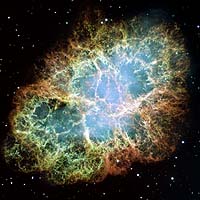
Hubble Takes Most Detailed Image Yet Of Crab Nebula
Baltimore MD (SPX) Nov 30, 2005 A new Hubble image - among the largest ever produced with the Earth-orbiting observatory - gives the most detailed view so far of the entire Crab Nebula. The Crab is arguably the single most interesting object, as well as one of the most studied, in all of astronomy. The image is the largest ever taken with Hubble's WFPC2 workhorse camera. The Crab Nebula is one of the most intricately structured and dynamic objects ever observed. The new Hubble image of the Crab was assembled from 24 individual exposures taken with the NASA/ESA Hubble Space Telescope's Wide Field and Planetary Camera 2 (WPFC2) and is the highest resolution image of the entire Crab Nebula ever made. The Crab Nebula is a six-light-year-wide expanding remnant of a star's supernova explosion. Japanese and Chinese astronomers witnessed this violent event nearly 1,000 years ago in 1054. The filaments are the tattered remains of the star and consist mostly of hydrogen. The rapidly spinning neutron star embedded in the centre of the nebula, only barely visible in this Hubble image, is the dynamo powering the nebula's eerie interior bluish glow. The blue light comes from electrons whirling at nearly the speed of light around magnetic field lines from the neutron star. The neutron star, like a lighthouse, ejects twin beams of radiation that appear to pulse 30 times a second due to the neutron star's rotation. A neutron star is the crushed ultra-dense core of the exploded star. The Crab Nebula derived its name from its appearance in a drawing made by British astronomer Lord Rosse in 1844, using a 36-inch telescope. When viewed by Hubble, as well as large ground-based telescopes such as ESO's Very Large Telescope, the Crab Nebula takes on a more detailed appearance that yields clues into the spectacular demise of a star, 6,500 light-years away. The newly composed image was assembled from individual Wide Field and Planetary Camera 2 exposures taken in October 1999, January 2000, and December 2000. The colours in the image indicate the different elements that were expelled during the explosion. Blue indicates neutral oxygen, green singly ionised sulphur and red doubly-ionised oxygen. The Hubble data have been superimposed onto images taken with the European Southern Observatory's Very Large Telescope at Paranal Observatory, Chile. Related Links Hubble at NASA European Southern Observatory SpaceDaily Search SpaceDaily Subscribe To SpaceDaily Express
 UCSC Physicists Deliver Detector For NASA's GLAST Telescope
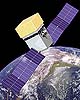 Santa Cruz CA (SPX) Nov 09, 2005
After more than a decade of work, a team led by physicists at the University of California, Santa Cruz, has completed a major detector subsystem for NASA's Gamma-ray Large Area Space Telescope (GLAST). |
|
|

| The content herein, unless otherwise known to be public domain, are Copyright 1995-2006 - SpaceDaily.AFP and UPI Wire Stories are copyright Agence France-Presse and United Press International. ESA PortalReports are copyright European Space Agency. All NASA sourced material is public domain. Additionalcopyrights may apply in whole or part to other bona fide parties. Advertising does not imply endorsement,agreement or approval of any opinions, statements or information provided by SpaceDaily on any Web page published or hosted by SpaceDaily. Privacy Statement |