|
 |
 |
 |
 |
 |
 |
 |
 |
 |

| . |  |
. |
UCSC Physicists Deliver Detector For NASA's GLAST Telescope
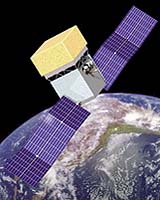
Santa Cruz CA (SPX) Nov 09, 2005 After more than a decade of work, a team led by physicists at the University of California, Santa Cruz, has completed a major detector subsystem for NASA's Gamma-ray Large Area Space Telescope (GLAST). Completion of the tracking detector is a significant milestone for the telescope project, scheduled for launch in 2007. GLAST will give astronomers a powerful new tool for studying the sources of high-energy gamma rays in the universe. It will help astronomers investigate poorly understood phenomena such as active galactic nuclei, quasars, pulsars, and gamma-ray bursts. Scientists also hope to learn about the fundamental properties of the universe itself by studying how gamma rays propagate across the universe. "With GLAST, we can look at gamma rays emitted from the farthest reaches of the universe and study the sources of those gamma rays. We expect that GLAST will see thousands of quasars and related objects," said Robert Johnson, a professor of physics at UCSC and manager of the tracker subsystem for the telescope. The tracking detector will give GLAST unprecedented sensitivity for detecting high-energy gamma rays and pinpointing their sources in the sky. The design, engineering, and fabrication of the detector was overseen by Johnson and other researchers at the Santa Cruz Institute for Particle Physics (SCIPP) at UCSC. The project was a collaborative effort involving SCIPP, the Stanford Linear Accelerator Center (SLAC), and institutions in Italy and Japan. GLAST will be much more powerful than its predecessor, the EGRET experiment that operated on the Compton Gamma Ray Observatory in the 1990s, Johnson said. "Currently there is no other telescope that can detect gamma rays within the energy range that GLAST will cover, and it will be 30 to 100 times more sensitive than any previous gamma-ray telescope," he said. The tracking detector has nearly 900,000 detector channels, each connected to its own amplifier. Packed into 16 compact modules are nearly 80 square meters of solid-state silicon detectors and 576 electronics boards, all supported on a carbon-composite structure. The whole system operates on just 160 watts of power, and it had to be designed to withstand severe vibrations during the rocket launch that will carry the telescope into orbit. "It is really an unprecedented design for a detector system that will be put into space," Johnson said. The initial design work for the GLAST detector was begun in 1992 by William Atwood, then at SLAC and now an adjunct professor of physics at UCSC. Johnson began collaborating with Atwood on the detector project in 1994, and in 2000, NASA chose their detector from among several competing designs for the GLAST mission. Three weeks ago, SCIPP scientists and their international team delivered the last of the detector modules to the integration and test team at SLAC, where the modules were installed into the overall instrument structure. Over the years, many UCSC undergraduates and graduate students have contributed to SCIPP's work on the GLAST project, Johnson said. In addition to Atwood and Johnson, other UCSC faculty involved in the project are Hartmut Sadrozinski and Terry Schalk, both adjunct professors of physics. High-energy astrophysicists at UCSC and elsewhere are eagerly awaiting the day when GLAST will begin collecting data. GLAST's main instrument, the Large Area Telescope for which the tracking detector was built, will provide unprecedented sensitivity to gamma rays in the energy range of about 20 MeV to about 300 GeV. Other space-based gamma-ray instruments, such as NASA's Swift mission, cover lower energy ranges, while new ground-based instruments will detect higher-energy gamma rays. "The new generation of ground-based gamma-ray observatories cover complementary energy ranges and will work closely with GLAST," Johnson said. "We are looking forward to quite an exciting time in terms of being able to reach into new energy ranges and hopefully find the answers to fundamental questions about the universe." Related Links SpaceDaily Search SpaceDaily Subscribe To SpaceDaily Express
 South Africa To Unveil Its Flagship "Eye Of Africa Into Space" Telescope
 Cape Town (AFP) Nov 09, 2005
The inauguration of the southern hemisphere's largest telescope Thursday near a small South African town would be a milestone towards realising the country's aim as a "first rate science" country, astronomers said this week.
--------------------------------------------------------- It's new. And it's downright terrific! Celestron's CPC Schmidt-Cassegrain telescope is the scope you've been waiting for! It offers new alignment technology, advanced engineering, and bold new design at a new, low price! In fact, Celestron's Professional Computerized (CPC) scope with revolutionary SkyAlign Alignment Technology redefines everything that amateur astronomers are looking for. It offers quick and simple alignment, GPS technology, unsurpassed optical quality, ease of use, advanced ergonomics, enhanced computerization and, most important, affordability. Want to view M-31 tonight? One button takes you there!
Shop for telescopes online at Telescopes.com! today!
|
|
|

| The content herein, unless otherwise known to be public domain, are Copyright 1995-2006 - SpaceDaily.AFP and UPI Wire Stories are copyright Agence France-Presse and United Press International. ESA PortalReports are copyright European Space Agency. All NASA sourced material is public domain. Additionalcopyrights may apply in whole or part to other bona fide parties. Advertising does not imply endorsement,agreement or approval of any opinions, statements or information provided by SpaceDaily on any Web page published or hosted by SpaceDaily. Privacy Statement |