|
 |
 |
 |
 |
 |
 |
 |
 |
 |

| . |  |
. |
Grant Renews Funding Of Research Toward Cloning Primates
Pittsburgh - Sep 01, 2003 The National Institutes of Health (NIH) has awarded nearly $6.4 million to the Pittsburgh Development Center, which is affiliated with the University of Pittsburgh, to fund investigation aimed at overcoming obstacles to cloning nonhuman primates. Cloning primates is vital to generate better research models for human disease so that studies obtain more accurate results with fewer animals. It also could lead to a greater understanding of the molecular biology of embryonic stem cells, which have the promise to treat disorders such as diabetes and Parkinson's disease as well as damaged hearts and other organs. The five-year grant award renews funding originally conferred in 1998 to principal investigator Gerald Schatten, Ph.D., director of the Pittsburgh Development Center (PDC) of the Magee-Womens Research Institute, and professor of obstetrics, gynecology and reproductive sciences and cell biology and physiology at the University of Pittsburgh School of Medicine. Co-investigators include Calvin Simerly, Ph.D.; Christopher Navara, Ph.D.; and Laura Hewitson, Ph.D., all of the PDC. "Valuable discoveries have been made � and continue to be made � using mice, rats and other genetically modified rodent species as models for human disease, yet many serious disorders often cannot be appropriately studied in these lower animals," said Dr. Schatten, who also is vice chair for research development and deputy director for biotechnology development at the Magee-Womens Research Institute. "Cloned and transgenic nonhuman primates could accelerate the safe and effective implementation of innovative treatments, including stem cell and gene therapies, as well as the understanding of the molecular basis of normal human development." Scientists at the Pittsburgh Development Center have ambitious goals for the five-year grant period, including overcoming fundamental molecular obstacles to cloning nonhuman primates first reported by the group in the April 11, 2003, edition of the journal Science. Despite using four common techniques of nuclear transfer in more than 700 eggs from rhesus macaques and 33 transfers of early embryos into surrogates, no pregnancies were established, Dr. Schatten and his colleagues reported. Among the key structures involved in cell division is the mitotic spindle, which functions to precisely align and separate chromosomes. However, in cells originating as a result of nuclear-transfer, examination of spindle configuration revealed chaotic structures and unequal chromosome counts. Even the most basic proteins involved in spindle formation were absent or inadequate, said Calvin Simerly, Ph.D., associate professor of obstetrics, gynecology and reproductive sciences at the University of Pittsburgh School of Medicine. "We have designed several strategies to try to overcome this barrier," said Dr. Simerly. Each involves specific manipulation of other vital cellular components and the calculated use of rhesus sperm to provide a "jump start" via fertilization. The specific aim is to generate at least 10 cloned nonhuman primates, said Dr. Schatten. Another goal is the production of at least eight sets of identical offspring through embryo splitting. Dr. Schatten and his colleagues have achieved a singular event of this in the past with Tetra, a rhesus monkey, born in 2000. "We already have a lot of preliminary data on these techniques and we already know the next step," said Dr. Schatten. "We've done a lot of the groundwork." While the PDC is blazing new medical trails, its scientists are mindful of the ethical and social responsibilities related to being at the forefront of these techniques. A scientific advisory board includes regional and national bioethicists, theologians and scholars who analyze the medical merits and societal implications of the PDC's goals and achievements. The ultimate goal in producing these animals is to give researchers appropriate models of human disease so that discoveries can be translated quickly from the laboratory bench to the patient's bedside. In the past, investigators have used identical mice to test new therapies. However, as research moves to more complex diseases such as AIDS, Alzheimer's disease and cancers, many scientists agree that a model closer to humans is needed. In addition, mice are not always effective as test subjects for human therapies because some human diseases do not manifest in them even after they have been genetically introduced into the mice. "Having identical monkeys is a key step in resolving some of these horrific illnesses and knowledgeably evaluating stem cell medicines," Dr. Schatten said. Related Links University of Pittsburgh Medical Center SpaceDaily Search SpaceDaily Subscribe To SpaceDaily Express
 New Swine Clone Offers Path To Xeno Transplants
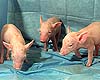 Auckland - Jan 15, 2003
In a session Monday at the annual meeting of the International Embryo Transfer Society (IETS), Randall Prather, Ph.D., Distinguished Professor of Reproductive Biotechnology at the University of Missouri-Columbia, announced the successful cloning of the first miniature swine with both copies of a specific gene "knocked out" of its DNA. |
|
|

| The content herein, unless otherwise known to be public domain, are Copyright 1995-2006 - SpaceDaily.AFP and UPI Wire Stories are copyright Agence France-Presse and United Press International. ESA PortalReports are copyright European Space Agency. All NASA sourced material is public domain. Additionalcopyrights may apply in whole or part to other bona fide parties. Advertising does not imply endorsement,agreement or approval of any opinions, statements or information provided by SpaceDaily on any Web page published or hosted by SpaceDaily. Privacy Statement |