|
 |
 |
 |
 |
 |
 |
 |
 |
 |

| . |  |
. |
New Swine Clone Offers Path To Xeno Transplants
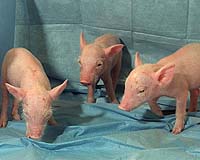
Auckland - Jan 15, 2003 In a session Monday at the annual meeting of the International Embryo Transfer Society (IETS), Randall Prather, Ph.D., Distinguished Professor of Reproductive Biotechnology at the University of Missouri-Columbia, announced the successful cloning of the first miniature swine with both copies of a specific gene "knocked out" of its DNA. The ultimate goal of this research, which is being conducted in partnership with Immerge BioTherapeutics, Inc (a BioTransplant Incorporated/Novartis Pharma AG joint venture company), is to develop a herd of miniature swine that can be used as a safe source for human transplantation, a process known as xenotransplantation. "The fact that we have been able to clone this particular strain of miniature swine with both copies of the gene that produces GGTA1 knocked out is a very exciting step for the field of xenotransplantation," said Dr. Prather, a researcher in MU's College of Agriculture, Food and Natural Resources. "Organs from regular swine are too large for human transplant, and this particular strain of miniature swine has been refined for years solely for its potential use in humans." New options for organ sources are desperately needed to treat the rapidly increasing number of critically ill people on the transplant waiting list (more than 80,000 in the U.S. alone). Researchers have targeted the pig as the best potential candidate for an alternative organ source because of the similarity between human and pig organs and the relative ease of breeding. However, the massive rejection response mounted by the human immune system has been a major hurdle in this research. A key player in this rejection process is the gene called a-1,3-galactosyltransferase or GGTA1 that produces a sugar molecule. When a foreign organ is introduced, human antibodies attach to the sugar molecule on the surface of pig cells produced from the action of the GGTA1 molecule, thus killing the organ. With both copies of this gene eliminated, the antibodies cannot attach, halting the early rejection process. Dr. Robert Hawley and scientists at Immerge, in collaboration with Dr. Kenth Gustafsson, first identified the gene that produces GGTA1 and eliminated, or knocked it out, of the DNA of the cells from the miniature swine. This genetic material was then sent to Dr. Prather's lab, where Dr. Liangxue Lai and colleagues implanted it into an egg that had its DNA eliminated. The egg was stimulated to begin dividing and was later implanted into a sow. Prather and Immerge announced in January 2002 in the journal Science that they had successfully cloned the world's first single knock-out miniature swine. The genetic material from these swine was then re-engineered with the aim of knocking out the second copy of this critical gene. These cells were then subjected to another round of nuclear transfer cloning, leading to the birth of the double knock-out piglet on November 18, 2002. In addition to the modified genetics, the Immerge miniature swine also have other important advantages as potential transplantation candidates. "The strain of swine we are working with seems to be incapable of transmitting Porcine Endogenous Retrovirus (PERV) to human cells in culture, as we reported in March 2002 in the Journal of Virology," said Julia Greenstein, Ph.D., CEO and President, of Immerge. "Unlike other viruses, which can be eliminated either through breeding or raising pigs in a clean lab environment, multiple copies of PERV form part of the normal genomic DNA of pigs and are therefore passed from one generation to the next. "Although the risk of any harm posed by PERV to xenotransplant recipients may be purely theoretical, use of this line of miniature swine would help minimize this particular risk of this new technology," said Dr. Greenstein. The University of Missouri-Columbia has a long-standing research collaboration with Immerge and BioTransplant Incorporated in the field of porcine genetic engineering. This close collaboration has allowed this important research to progress at an accelerated pace. The current collaboration is supported by a National Institutes of Health Small Business Innovative Research grant. Immerge BioTherapeutics was formed on September 26, 2000, as a joint venture between Novartis Pharma AG and BioTransplant Incorporated. The company, which began operations on January 2, 2001, focuses its research efforts toward developing therapeutic applications for xenotransplantation. The name of the company derives from its use of immunology to address the challenges of conducting transplants between species. Related Links SpaceDaily Search SpaceDaily Subscribe To SpaceDaily Express
 Scientists Identify 'Master' Molecule That Controls Action Of Many Genes
 xxx - Nov 19, 2002
UCSF-led scientists have identified the first "master" molecule in the cell nucleus that controls the action of hundreds of different genes at once through its action on enzymes. |
|
|

| The content herein, unless otherwise known to be public domain, are Copyright 1995-2006 - SpaceDaily.AFP and UPI Wire Stories are copyright Agence France-Presse and United Press International. ESA PortalReports are copyright European Space Agency. All NASA sourced material is public domain. Additionalcopyrights may apply in whole or part to other bona fide parties. Advertising does not imply endorsement,agreement or approval of any opinions, statements or information provided by SpaceDaily on any Web page published or hosted by SpaceDaily. Privacy Statement |