| . |  |
. |
| . | |
. |


 by Amy Wallace Washington (UPI) Aug 22, 2017
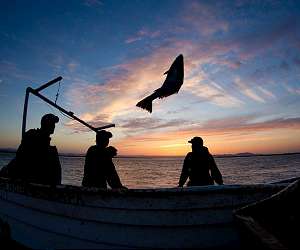
Scientists at the University of Illinois at Urbana-Champaign found that largemouth bass whose cortisol levels rise after stress are harder to catch by angling. The study, published today in the Journal of Experimental Biology, could impact recreational fishing if anglers are mainly catching fish whose stress levels determine if they are likely to strike at a lure. "We could potentially be selecting for fish that are harder to catch," Cory Suski, University of Illinois natural resources and environmental sciences professor, said in a press release. This phenomenon is known as fisheries-induced evolution, which happens when people catch fish with specific traits and leave genetically distinct fish remaining. Previous studies have shown that by catching only the largest fish, commercial fishing operations may alter the growth patterns of the fish that are not caught, causing smaller fish in the population. Those studies focused on personality traits such as aggression or boldness, but the current study has found that stress hormones are likely the cause. "When it encounters a challenge or novel situation, a fish's adrenaline shoots up, and that individual is more likely to attack or run away," said Michael Louison, a researcher at the University of Illinois. "But if an animal shows a relatively high cortisol response and a low adrenaline response, they're more likely to freeze." Researchers took blood samples from 113 largemouth bass, exposed the fish to the open air for three minutes, and then returned them to the water where they recovered for a period of time before a second blood sample was taken. The researchers found a substantial link between stress-related cortisol levels in the fish and their likelihood of being captured by angling. Cortisol levels tested after the stressor were 48 percent higher in fish that were never caught compared to those that had been caught and returned.
 Japanese seaweed is welcome invader on US coasts: study
Miami (AFP) July 17, 2017 A kind of Japanese seaweed that is considered an invasive species in the United States is actually serving an important role in restoring barren and vulnerable coastlines, US researchers said Monday. In many lagoons and estuaries of the North Atlantic, native seagrasses and oyster beds have been "severely reduced," due to global warming, pollution, disease and overharvesting, said the report ... read more Related Links Water News - Science, Technology and Politics

|
|||||||||||||
| The content herein, unless otherwise known to be public domain, are Copyright 1995-2026 - SpaceDaily. All websites are published in Australia and are solely subject to Australian law and governed by Fair Use principals for news reporting and research purposes. By using our websites you consent to cookie based advertising. If you do not agree with this then you must stop using the websites from May 25, 2018. Privacy Statement. Additional information can be found here at About Us. |

 del.icio.us
 Digg
Digg Reddit
 Google






