
 |
 |
 |
 |
 |
 |
 |
 |
 |
 |

| . |  |
. |
|
Chandra Switched To Redunant Engines For Last Burn 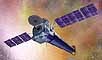 Huntsville - August 2, 1999 - The fourth of five scheduled firings of the propulsion system aboard NASA's Chandra X-ray Observatory has been postponed until 12:36 p.m. EDT, Wednesday, Aug. 4. The burn had been scheduled for 12:35 a.m. EDT, Monday, Aug. 2.
The change was made to allow the flight operations team in Cambridge, Mass., time to configure the observatory's redundant set of liquid apogee engines. A decision to use the redundant engines was made after a review of orbital parameters and Integral Propulsion System performance data from Saturday's 21-and-a-half-minute burn. Saturday's burn raised the high-point, or apogee, of Chandra's orbit to 86,433 miles (139,100 kilometers). This is very slightly -- about 559 miles (900 kilometers) -- lower than the predicted 86,992 miles (140,000 kilometers), but is well within specifications, emphasized Chandra managers. Specifications call for the observatory's operating apogee to be between 83,885 and 90,099 miles (135,000 and 145,000 kilometers). "While the propulsion system performed within specifications and has delivered us to a completely acceptable apogee altitude, the performance of Chandra's engine number 3 was slightly below expectations," said NASA Program Manager Fred Wojtalik. "That is leading us to take a conservative approach and switch to the redundant system as a precaution." NASA's Marshall Space Flight Center in Huntsville, Ala., manages the Chandra X-ray Observatory for NASA's Office of Space Science, NASA Headquarters, Washington, D.C. The Smithsonian Astrophysical Observatory in Cambridge, Mass., manages the Chandra science program and controls the observatory for NASA. TRW Space and Electronics Group of Redondo Beach, Calif., leads the contractor team that built Chandra.
Chandra Reports at SpaceDaily
|
|
| ||||||||
| The content herein, unless otherwise known to be public domain, are Copyright 1995-2016 - Space Media Network. All websites are published in Australia and are solely subject to Australian law and governed by Fair Use principals for news reporting and research purposes. AFP, UPI and IANS news wire stories are copyright Agence France-Presse, United Press International and Indo-Asia News Service. ESA news reports are copyright European Space Agency. All NASA sourced material is public domain. Additional copyrights may apply in whole or part to other bona fide parties. Advertising does not imply endorsement, agreement or approval of any opinions, statements or information provided by Space Media Network on any Web page published or hosted by Space Media Network. Privacy Statement All images and articles appearing on Space Media Network have been edited or digitally altered in some way. Any requests to remove copyright material will be acted upon in a timely and appropriate manner. Any attempt to extort money from Space Media Network will be ignored and reported to Australian Law Enforcement Agencies as a potential case of financial fraud involving the use of a telephonic carriage device or postal service. |
