
 |
 |
 |
 |
 |
 |
 |
 |
 |
 |

| . |  |
. |
Chandra On-Orbit With X-ray Vision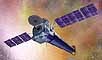 August 9, 1999 - The NASA Chandra X-ray Observatory�s engines were ignited for a fifth time at 1:43 a.m. EDT August 7, delivering the world�s latest space telescope to its operating orbit, where it will probe the deepest regions of the universe with the most powerful X-ray imaging systems ever used in space.
The seven-minute, 44-second firing of the observatory�s Integral Propulsion System raised Chandra�s perigee to an estimated 6,012 miles (9,676kilometers), leaving its apogee, or high point, essentially unchanged at 86,458 miles (139,141 kilometers). "Initial indications are that all went as planned," said NASA�s Chandra Program Manager Fred Wojtalik, of the Marshall Space Flight Center in Huntsville, Ala. "The flight operations team will carefully review the observatory�s orbital parameters over the next 24 hours to verify that we are where we need to be." Meanwhile, the Chandra control team continues to activate and check-out the observatory�s instruments. In the last 48 hours, controllers continued calibration of both the High Resolution Camera and the Advanced Charged Coupled Imaging Spectrometer. A review of data from the August 4 firing of the Chandra X-ray Observatory Integral Propulsion System now indicates the backup engines performed as expected. Analysis confirms Wednesday's initial indications that the engines performed well. The five-minute burn positioned the telescope in a new perigee of 3515 miles (5,657 kilometers), and apogee of 86,458 miles (139,141 kilometers), with an orbital period of 61 hours and 7.3 minutes.
Chandra Reports at SpaceDaily
|
|
| ||||||||
| The content herein, unless otherwise known to be public domain, are Copyright 1995-2016 - Space Media Network. All websites are published in Australia and are solely subject to Australian law and governed by Fair Use principals for news reporting and research purposes. AFP, UPI and IANS news wire stories are copyright Agence France-Presse, United Press International and Indo-Asia News Service. ESA news reports are copyright European Space Agency. All NASA sourced material is public domain. Additional copyrights may apply in whole or part to other bona fide parties. Advertising does not imply endorsement, agreement or approval of any opinions, statements or information provided by Space Media Network on any Web page published or hosted by Space Media Network. Privacy Statement All images and articles appearing on Space Media Network have been edited or digitally altered in some way. Any requests to remove copyright material will be acted upon in a timely and appropriate manner. Any attempt to extort money from Space Media Network will be ignored and reported to Australian Law Enforcement Agencies as a potential case of financial fraud involving the use of a telephonic carriage device or postal service. |
