| SPACE TRAVEL | MILITARY SPACE | EARTH SCIENCES | SPACE BUSINESS | MARS DAILY |

|
|
|
|
|||||||||||||
| PREVIOUS ISSUE OF SPACEDAILY |
NASA Statement On False Claim Of Evidence Of Life On Mars Washington (SPX) Feb 18, 2005
News reports originally reported by Space.com on February 16, 2005, that NASA scientists from Ames Research Center, Moffett Field, Calif., have found strong evidence that life may exist on Mars are incorrect. Exploring The Other Globe 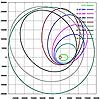 Moffett Field CA (SPX) Feb 22, 2005
SMART-1 is now at the moon, mapping the surface mineralogy. Future missions can use the technology being tested by SMART-1 to go to Mars, Venus, Mercury, comets, and the sun. In this article, Bernard Foing, Chief Scientist at ESA and Project Scientist for SMART-1, explains what finding water on the moon could mean for future exploration. Looking Through The Hubble Space Telescope With An Artist's Eye  Chicago IL (SPX) Feb 21, 2005
The spectacular images from the Hubble Space Telescope circulate far beyond the scientific community. From postage stamps to the cover of Pearl Jam Cds, images collected by the Hubble Space Telescope have become part of American culture. |
Ariane 5 Technology Turns The Lights On Paris (ESA) Feb 22, 2005
Soon we may be able to fill the bath, turn the lights on and play our favourite CD without moving from our chair or pressing a button. Technology, developed by ESA for European spacecraft, is now being used to create small sensors that can make any flat surface � walls, windows or tables � interactive. Billions Investment Needed for Hydrogen Infrastructure By 2012: ABI Research  Oyster Bay NY (SPX) Feb 16, 2005
The embryonic automotive fuel cell industry - whether or not aided by governments - must invest some US$2 billion in creating a hydrogen fueling station infrastructure by 2012 if market expectations are to be met. A Breakout Year For Tags  Chicago (SPX) Feb 18, 2005
This could be the year Radio Frequency Identification technology achieves its long-expected mass-market success -- with the wireless tags being used everywhere from schoolyards to convenience stores, experts told UPI's Wireless World. |
|
String Theorist Explores Dark Energy And Our Unique 'Pocket' Of The Universe Washinton DC (SPX) Feb 18, 2005
Some celestial bodies are so cold that methane freezes; others are so hot that nuclear reactions occur. And then there's Earth, with a benign temperature hovering in the narrow range between freezing and boiling, allowing the existence of liquid water-and life. Einstein@Home Goes Live In Search For Gravitational Waves  Washington DC (SPX) Feb 21, 2005
A new grassroots computing project dubbed Einstein@Home, which will let anyone with a personal computer contribute to cutting edge astrophysics research, was officially launched at the annual meeting of the American Association for the Advancement of Science in Washington DC on Saturday, February 19. Super-Heavy Nuclei Take Shape In 'Extreme' New Theories  Oak Ridge TN (SPX) Feb 21, 2005
Advanced computational methods and supporting experiments are giving scientists a better understanding of the nature and stability of superheavy nuclei and the heaviest elements that lie beyond the borders of the periodic table. |
Ultra-Cold Temperature Physics Opens Way To Understanding And Applications Washington DC (SPX) Feb 22, 2005
Researchers doing ultra-cold temperature physics may not have to wear parkas, but they are producing the coldest temperatures ever and exploring model quantum systems that might lead to more accurate clocks and gyroscopes, quantum computers and communications. Big Pharma Neglecting Nanotech  New York (UPI) Feb. 18, 2005
The U.S. pharmaceutical giants are investing almost no money and talent in nanotechnology, experts told UPI's Nano World. "The impact of nanotechnology on pharmaceuticals is not 10 years from now - it's two or three," said Matthew Nordan, vice president of research at Lux Research, a nanotech analysis firm. Astronomers Measure Mass Of Smallest Black Hole In A Galactic Nucleus  Washington DC (SPX) Feb 21, 2005
A group led by astronomers from Ohio State University and the Technion-Israel Institute of Technology have measured the mass of a unique black hole, and determined that it is the smallest found so far. |
|
| The contents herein, unless otherwise known to be public domain, are Copyright 1995-2005 - SpaceDaily. AFP and UPI Wire Stories are copyright Agence France-Presse and United Press International. ESA Portal Reports are copyright European Space Agency. All NASA sourced material is public domain. Additional copyrights may apply in whole or part to other bona fide parties. Advertising does not imply endorsement, agreement or approval of any opinions, statements or information provided by SpaceDaily on any web page published or hosted by SpaceDaily. Privacy Statement |