

|
|
PREVIOUS ISSUE
MARSDAILY SPACEMART SPACEWAR SPACE TRAVEL TERRADAILY ASTRONAUTIX EMAIL US /ABOUT US SPACEDAILY FORUMS Paid Shopping Links 
|
 BREAKING NEWS
Spirit drills first hole in Mars rock Pasadena - Feb 08, 2004 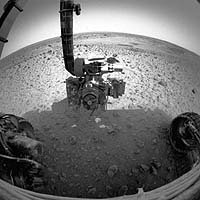 The US Mars rover Spirit drilled a tiny, circular hole in a rock, a first in the history of exploring the planet, the US space agency NASA said Saturday.
 |

|
US Army Awards Northrop Grumman WMD Management Contract Herndon - Feb 09, 2004
Northrop Grumman has been selected by the U.S. Army to provide research, development, and engineering program and integration support services. These services will help the Army's Research, Development, and Engineering Command (RDECOM) achieve its mission of developing, acquiring and sustaining soldier support as well as chemical, biological, radiological, and nuclear-defense technology systems and services. Hybrid Satellite Heralds New Era In Communications  Richmond, B.C - Feb 09, 2004
Canada will transform the future of space-based data delivery and lead cutting-edge scientific research about space weather with the launch of its first multi-purpose satellite mission announced recently. |
SMART-1 Ion Engine Switched Off and Commissioning Begins Paris (ESA) Feb 09, 2004
The spacecraft is now in its 207th orbit, in good status and with all functions performing nominally. As in previous weeks, the ion drive has only generated thrust around the perigee point to fine-tune the altitude of the apogee point. This strategy has produced a noticeable increase in apogee height, see plot below, which is necessary to minimize the duration of eclipse periods that will occur during March. Rosetta Lander Named Philae  Paris (ESA) Feb 09, 2004
With just 17 days to the launch of the European Space Agency's Rosetta comet mission, the spacecraft's lander was named "Philae" in a ceremony last week in Paris. Rosetta embarks on a 10-year journey to Comet 67P/Churyumov-Gerasimenko from Kourou, French Guiana, on 26 February. |
Alcatel Signs Contract With Worldsat Paris - Feb 09, 2004
Alcatel Space announced the signature of a contract to build and deliver, in orbit, a new telecommunications satellite for WORLDSAT, LLC, a SES GLOBAL company. This advanced, high-powered hybrid C/Ku-band satellite, named WORLDSAT-3, will operate over the pacific region. EADS Space Wins Contract To Define Mars Sample Return Missions  Friedrichshafen - Feb 09, 2004
EADS Space has been awarded a EUR600k Study by ESA to carry out the first definition of a European Mars Sample Return (MSR) mission. The study will benefit from the combined resources of EADS Astrium and EADS Space Transportation. EADS Astrium Wins Study For First European Mars Rover  Friedrichshafen - Feb 09, 2004
EADS Space has been awarded a EUR900k study by ESA to carry out the first definition of a Rover to explore the Martian surface and search for life. |
An Abrasive Collision Gives One Galaxy A "Black Eye"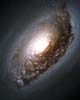 Baltimore - Feb 09, 2004
A collision of two galaxies has left a merged star system with an unusual appearance as well as bizarre internal motions. Messier 64 (M64) has a spectacular dark band of absorbing dust in front of the galaxy's bright nucleus, giving rise to its nicknames of the "Black Eye" or "Evil Eye" galaxy. Oxygen And Carbon Found In Atmosphere Of An Extrasolar Planet  Baltimore - Feb 09, 2004
NASA's Hubble Space Telescope has detected, for the first time ever, the presence of oxygen and carbon in the atmosphere of a planet outside our solar system. Satlynx and Cisco Team Up Terrestrial Wireless Broadband  Luxembourg - Feb 09, 2004
Satlynx S.A. and Cisco Systems Inc. are announcing their decision to work together on the development of high-speed internet services. |
New Study Shows How Black Holes Get Their "Kicks" Rochester - Feb 09, 2004
When black holes collide, look out! An enormous burst of gravitational radiation results as they violently merge into one massive black hole. The "kick" that occurs during the collision could knock the black hole clear out of its galaxy. Livermore Scientists Team With Russia To Discover Elements 113 and 115  Livermore - Feb 09, 2004
Scientists from the Glenn T. Seaborg Institute and the Chemical Biology and Nuclear Science Division at the Lawrence Livermore National Laboratory, in collaboration with researchers from the Joint Institute for Nuclear Research in Russia (JINR), have discovered the two newest super heavy elements, element 113 and element 115. Supernova Blast Bonanza In Nearby Galaxy  Baltimore - Feb 09, 2004
The nearby dwarf galaxy NGC 1569 is a hotbed of vigorous star birth activity which blows huge bubbles that riddle the main body of the galaxy. The galaxy's "star factories" are also manufacturing brilliant blue star clusters. This galaxy had a sudden and relatively recent onset of star birth about 25 million years ago, which subsided about the time the very earliest human ancestors appeared on Earth. |
One Type Of Carbon So Resilient It Skews Carbon Cycle Calculations Seattle - Feb 09, 2004
Scientists interested in the Earth's carbon cycle � something that must be understood to assess the ongoing effects of carbon dioxide created by human actions, such as driving cars � have a new problem. They need to adjust various calculations because one component, graphitic black carbon, similar to the material found in pencil lead, turns out to be so tough. Increasing Greenhouse Gases Lead To Dramatic Thinning Of The Upper Atmosphere  Washington - Feb 09, 2004
The highest layers of the Earth's atmosphere are cooling and contracting, most likely in response to increasing levels of greenhouse gases, according to a new study by scientists at the Naval Research Laboratory. Scientists Find Ozone-destroying Molecule  Washington - Feb 09, 2004
For years, scientists theorized that a molecule called ClOOCl in the stratosphere played a key role in destroying ozone. Now, using measurements from a NASA aircraft laboratory flying over the Arctic, Harvard scientist Rick Stimpfle and colleagues observed the molecule for the first time. They report their discovery in the Journal of Geophysical Research-Atmospheres, published by the American Geophysical Union. |
Galileo: Issues Still To Be Solved Before Agreement With The U.S. Brussels - Feb 09, 2004
The European Commission announced that discussion with the Americans regarding the Galileo project are going well but that two issues must be solved before an agreement can be reached. First, coexistence of Galileo's commercial signal and the GPS military encrypted signal must be possible in an emergency situation. |
Nanotech Research Leads To New Semiconductor Manufacturing Techniques Amherst - Feb 09, 2004
Research findings published by University of Massachusetts Amherst scientists demonstrate how nanotechnology can be used in the manufacturing of very small integrated circuits, using supercritical fluids to transfer the three-dimensional structure of polymer templates into rigid, ceramic-like films. The findings appear in the January 23, 2004 issue of Science. |
|
| The contents herein, unless otherwise known to be public domain, are Copyright 1995-2004 - SpaceDaily. AFP Wire Stories are copyright Agence France-Presse ESA Portal Reports are copyright European Space Agency. Additional copyrights may apply in whole or part to other bona fide parties. Advertising does not imply endorsement, agreement or approval of any opinions, statements or information provided by SpaceDaily on any web page published or hosted by SpaceDaily. Privacy Statement |