| . |  |
. |
| . | |
. |


When Is A Metal Not A Metal
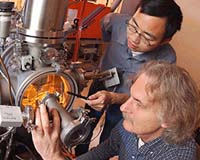
Gainsville - May 27, 2003 Niobium clusters display non-metallic properties at ultra-cold temperatures The May 23 issue of the journal Science answers that question with an account of the surprising behavior exhibited by nanometer-scale clusters of the metal niobium. When the clusters are cooled to below 20 degrees Kelvin, electrical charges in them suddenly shift, creating structures known as dipoles. "This is very strange, because no metal is supposed to be able to do this," said Walter de Heer, a professor in the School of Physics at the Georgia Institute of Technology and co-author of a paper to be published on the topic in Science. "These clusters become spontaneously polarized, with electrons moving to one side of the cluster for no apparent reason. One side of each cluster becomes negatively-charged, and the other side becomes positively-charged. The clusters lock into that behavior and stay that way." This ferroelectric phenomenon has so far been observed in clusters of niobium, vanadium and tantalum � three transition metals that in bulk form become superconducting at about the same temperature that the researchers observe formation of dipoles in the tiny clusters. De Heer believes this discovery will open up a new field of research � and provide clues to the mystery of superconductivity. In bulk metals � and even in niobium clusters at room temperature -- electrical charge is normally distributed equally throughout the sample unless an electric field is applied to them. But in the clusters of up to 200 niobium atoms created by de Heer and collaborators Ramiro Moro, Xiaoshan Xu and Shuangye Yin, that changes when the particles are cooled to less than 20 degrees Kelvin. The Georgia Tech researchers discovered this "spontaneous symmetry breaking" while searching for signs of superconductivity in the nanometer-scale clusters. It was completely unexpected � and de Heer admits he has no explanation for it. "When this happens, these particles that are made out of metal atoms no longer behave as if they were metallic," he said. "Something changes the particles from a metal into something else." For the smallest clusters, the strength of the dipole effect varies dramatically according to size. Clusters composed of 14 atoms display strong effects, while those made up of 15 atoms show little effect. Above 30 atoms, clusters with even numbers of atoms display stronger dipole effects than clusters with odd numbers of atoms. "Structure matters greatly to this process," de Heer said. "A small change can affect the position of the phase transition rather profoundly, and the exact arrangement of atoms really does matter to these systems." He attributes the size sensitivity to the quantum size regime, which is related to restrictions on how electrons can move in very small clusters. De Heer sees strong "circumstantial evidence," but no solid proof, that the phenomenon is connected to superconductivity in these metals. "Our assumption is that superconductivity in the bulk materials has something to do with the spontaneous production of dipole in the small particles," he said. "At this point, it is circumstantial evidence � the same materials and the same temperature regime, and the odd phase transitions occurring in both. By studying several different metals, we found that those that are superconducting in bulk have this effect, and those that are not superconducting do not have it. That strengthens our belief that this is connected to superconductivity in some way that we don't yet understand." To produce and study the tiny clusters, the researchers use a custom-built apparatus that includes a laser, large vacuum chamber, liquid helium and a specially designed detector able to count and characterize several million particles per hour. First, a laser beam is aimed at a niobium rod held within the vacuum chamber. Pulses from the laser vaporize the niobium, creating a cloud of metallic vapor. A stream of very cold helium gas is then injected into the chamber, causing the niobium gas to condense into particles of varying sizes. Under pressure from the ultra-cold helium, the particles exit through a small hole in the chamber's wall, creating a one millimeter-wide jet of particles that passes between two metal plates before hitting the detector. At intervals one minute apart, the metal plates are energized with 15,000 volts, creating a strong electrical field. The field interacts with the polarized niobium nanoclusters, causing them to be deflected away from the detector. Unpolarized clusters remain in the beam and are counted by the detector By comparing detector readings while the plates are energized against the readings when no field is applied, the researchers learn which clusters carry the dipole. The continuous production of particles allows de Heer's research team to gather data on millions of particles during each experiment. By varying the temperature and voltage, they study the impact of these changes on the effect. So far, they have studied in detail clusters of up to 200 atoms, though de Heer believes the effect should continue in larger clusters, perhaps up to 500 atoms or as many as 1,000. "This is just the beginning of what will ultimately be a very exciting story," he said. "We certainly have a lot of work to do. Related Links Walter de Heer's Research Group Georgia Tech SpaceDaily Search SpaceDaily Subscribe To SpaceDaily Express
 Clemson Inflatable Fabric Airlock Breezes Through Initial Tests
 Clemson - May 27, 2003
Space just got skinnier: an inflatable fabric airlock could become standard equipment on future space stations after breezing through its prototype testing in April. |
|
|

| The content herein, unless otherwise known to be public domain, are Copyright 1995-2006 - SpaceDaily.AFP and UPI Wire Stories are copyright Agence France-Presse and United Press International. ESA PortalReports are copyright European Space Agency. All NASA sourced material is public domain. Additionalcopyrights may apply in whole or part to other bona fide parties. Advertising does not imply endorsement,agreement or approval of any opinions, statements or information provided by SpaceDaily on any Web page published or hosted by SpaceDaily. Privacy Statement |