| . |  |
. |
| . | |
. |


Walker's World: Iraq's Votes Define U.S. Future
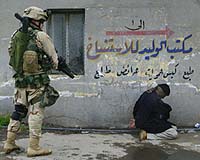
Washington (UPI) Jan 24, 2005 This week may see the decisive battle of America's future. Six days from now, Iraqis go to the polls to elect what may or may not be seen as a legitimate new government. The verdict, of the Iraqis themselves, of the wider Arab world and the international community -- including those dwindling allies who remain in Iraq taking their risks alongside the American troops -- will depend on the ability of the U.S. military and the Iraqi security forces to beat back the insurgents. If they can hold the polling stations for a day and allow the vast bulk of the Shiites and Kurds to vote, that will be a partial success. But unless they can claim that votes were cast by at least a decent proportion of the Sunni, which will probably be somewhere between 30 percent and 50 percent, then the partial success may not be enough for legitimacy. The odds probably favor the insurgents. They appear to be well buried inside the Sunni community. They are ruthless -- and enough of them were trained by Saddam Hussein's old Mukhabarat, the secret police -- to be experts in the dirtier arts of manipulation and intimidation. They know how to terrify, and they have been reminding their fellow Sunni that the Americas will leave someday, but the insurgents will stay and never forget those Sunni "traitors" who took part in this election. And yet the American troops and their Iraqi allies must strain every nerve to prevail, and if they cannot adequately defend the voting booths, they will have to ignore the election results to install a decent proportion of Sunni figures in the new assembly and the new government. The reason is simple. To defend the American occupation of Iraq is to defend the indefensible. What has to be defended, for American self-respect as well as for world opinion, is Iraqi democracy and Iraqi legitimacy. The sooner a representative Iraqi government is installed in Baghdad and sovereign in its own territory, with the right to ask the Americans to leave and be obeyed, the more the Bush administration's policy can be justified to a skeptical world and to troubled Americans. Why is this so important? Superpowers cannot take defeats; once they are humiliated, they start ceasing to be superpowers. And one of the salient features of the world that is emerging in what we shall soon be calling the Bush era is that America's superpower role is coming into question. Quite simply, the United States is losing its power to intimidate. From the first Gulf War, when the world first saw the video footage of American smart weapons hitting bridges and air vents on targeted buildings as their invulnerable Stealth aircraft flew nonchalantly overhead, the United States has been the unquestioned military hegemon. That perception of almost effortless American primacy continued through the second Gulf war, when one U.S. mechanized infantry division, with some airborne, Marine and British help, easily destroyed what had been the most powerful military in the Arab world. And now it has gone. The smart weapons and the Stealth bombers are not much use in an urban guerrilla war. The United States can kill an army, but it cannot defeat an insurgency. When Sen. Edward Kennedy last week called Iraq "Bush's Vietnam," he was putting into words the suspicions of other politicians around the world; this American superpower looks as if it has feet of clay. As the United States seems to be losing in Iraq, its fading powers to intimidate are also on display in North Korea and Iran, where American threats and diplomatic pressure do not seem to have deflected those two governments from their nuclear weapons programs. And Iran and North Korea are charter members of Bush's original "Axis of Evil." So if Bush's rhetoric on Iran and North Korea proves hollow, what is to deter Turkey or Egypt or Brazil or South Korea or Taiwan from developing their own nuclear weapons? And bear in mind that one lesson of Iraq's defeat and North Korea's survival is that nuclear arsenals are the one tool that seems to guarantee a country immunity from American invasion. Nukes are great equalizers, and if superpower America can no longer intimidate countries to stay nuclear-free, then nukes are going to proliferate. There is another reason why American's power to intimidate is fading. Let us put that more kindly. There is another reason why the United States is losing its ability to impress and to encourage others to adopt the American model. Under the Presidency of George W. Bush, the U.S. looks to be going broke. Last week, the U.S. trade deficit for December was announced, a record-breaking $60 billion, or $2 billion a day. That is an annual rate of over $700 billion. This year's U.S. federal budget deficit is going to come very close to $500 billion (once we include the inevitable supplemental budget for Iraq). That is an unprecedented double deficit of $1.2 trillion, more than 10 percent of GDP. The United States remains the richest single nation in the world, with its $11 trillion economy. But the European Union boasts a bigger GDP, a stronger currency, and dominance of the civil aviation industry. China is on track to match the U.S. economy within 30 years, and India should do so in 40 years. No wonder the Europeans and others suspect that the United States may be a weakening giant, that its powers are past their peak, and that its version of liberal capitalist democracy and its principles of free markets, free speech and free ideas may not be destined for universal acceptance. That is why this week's battle for the ballots in Iraq is so important. The United States is perceived to be losing not just a war but also a battle of ideas and values in which American principles as well as its prestige are at stake. The Jan. 30 elections are no longer just about Iraq, or just about democracy in the Arab world. They are about America's future. Related Links SpaceDaily Search SpaceDaily Subscribe To SpaceDaily Express
 Analysis: Putin Discards His Reform Allies
 Washington (UPI) Jan 24, 2005
The headline in the Moscow Times Monday said it all: "Liberal ministers take the blame." The three champions of aggressive free market -type reforms in the current Russian government appear being set up to walk the plank for their disastrously bungled welfare benefits reform. |
|
|

| The content herein, unless otherwise known to be public domain, are Copyright 1995-2006 - SpaceDaily.AFP and UPI Wire Stories are copyright Agence France-Presse and United Press International. ESA PortalReports are copyright European Space Agency. All NASA sourced material is public domain. Additionalcopyrights may apply in whole or part to other bona fide parties. Advertising does not imply endorsement,agreement or approval of any opinions, statements or information provided by SpaceDaily on any Web page published or hosted by SpaceDaily. Privacy Statement |