| . |  |
. |
| . | |
. |


 by Staff Writers Greenbelt MD (SPX) Sep 30, 2016
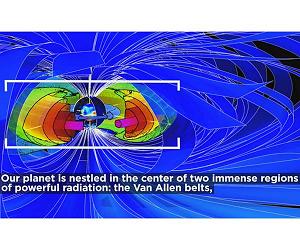
Our planet is nestled in the center of two doughnut-shaped regions of powerful, dynamic radiation: the Van Allen belts, where high-energy particles are trapped by Earth's magnetic field. Depending on incoming radiation from the sun, they can gain energetic particles. On the other hand, the belts can lose energized particles too. We are familiar with rapid changes in weather, and the radiation belts can experience these too - particles can be depleted by a thousand-fold in mere hours. These dramatic loss events are called drop-outs, and they can happen when intense bouts of solar radiation disturb Earth's magnetic environment. There have been many theories on how this happens, but scientists have not had the data to pinpoint which one is correct. However, on Jan. 17, 2013, NASA's Van Allen Probes were in just the right position to watch a drop-out in progress and resolve a long-standing question as to how the lower region of the belts close to Earth loses high-energy electrons - known as ultra-relativistic electrons for their near-light speeds. During a drop-out, a certain class of powerful electromagnetic waves in the radiation belts can scatter ultra-relativistic electrons. The electrons stream down along these waves, as if they are raining into the atmosphere. A team led by Yuri Shprits of University of California in Los Angeles published a paper summarizing these findings in Nature Communications on Sept. 28, 2016. Such information helps illustrate the complexity of Earth's magnetic surroundings. Understanding changes within the belts is crucial for protecting the satellites and astronauts travelling through this sometimes harsh space environment.
Related Links Van Allen Probes at NASA Earth Observation News - Suppiliers, Technology and Application
|
|||||||||||||
| The content herein, unless otherwise known to be public domain, are Copyright 1995-2026 - SpaceDaily. All websites are published in Australia and are solely subject to Australian law and governed by Fair Use principals for news reporting and research purposes. By using our websites you consent to cookie based advertising. If you do not agree with this then you must stop using the websites from May 25, 2018. Privacy Statement. Additional information can be found here at About Us. |


 del.icio.us
 Digg
Digg Reddit
 Google