24/7 Space News
TIME AND SPACE
Two dimensional crystal reveals hexatic phase in real time
illustration only

Two dimensional crystal reveals hexatic phase in real time

by Robert Schreiber
Vienna, Austria (SPX) Dec 05, 2025

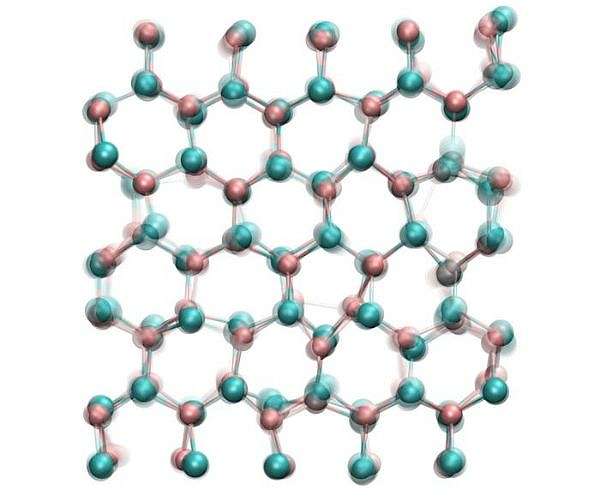
When three dimensional materials melt, the transition from an ordered solid to a disordered liquid usually occurs abruptly once the melting temperature is reached. In atomically thin systems, theory predicts a more complex route in which an intermediate state known as the hexatic phase appears between solid and liquid.

An international team led by the University of Vienna has now directly observed this hexatic phase in an atomically thin crystal of silver iodide AgI, resolving a question that has remained open since the phase was first proposed in the 1970s. In the hexatic state, the material shows liquid like disorder in the spacing between atoms, while the angular arrangement of atoms retains a degree of order.

To probe this behavior in a real material, the researchers encapsulated a single layer of silver iodide between two graphene sheets, forming a protective graphene sandwich that stabilized the fragile crystal while still allowing it to melt. Using a scanning transmission electron microscope equipped with a heating holder, they increased the temperature of the encapsulated layer to more than 1100 C and recorded atomic scale movies of the melting process.

"Without the use of AI tools such as neural networks, it would have been impossible to track all these individual atoms," explains Kimmo Mustonen from the University of Vienna, senior author of the study. The team first trained a neural network on large sets of simulated data and then applied it to thousands of high resolution images from the experiment to follow the motion and rearrangement of atoms during heating.

The analysis showed that, within a narrow temperature range about 25 C below the melting point of AgI, the crystal entered a distinct hexatic phase. Additional electron diffraction measurements supported this conclusion and provided independent evidence that an intermediate state exists in atomically thin, strongly bound silver iodide.

The observations also exposed a departure from standard theoretical expectations for two dimensional melting. While the transition from solid to hexatic followed a continuous evolution, the subsequent change from hexatic to liquid occurred abruptly, resembling the sudden melting familiar from bulk ice and other three dimensional systems.

"This suggests that melting in covalent two dimensional crystals is far more complex than previously thought," says David Lamprecht from the University of Vienna and the Vienna University of Technology TU Wien, a lead author of the study alongside Thuy An Bui from the University of Vienna. The work indicates that real materials can follow melting pathways that differ from idealized models developed for two dimensional systems.

According to group leader Jani Kotakoski from the University of Vienna, "Kimmo and his colleagues have once again demonstrated how powerful atomic resolution microscopy can be." The combination of advanced electron microscopy, in situ heating and AI based image analysis allowed the team to identify phase behavior that had not been accessible in covalently bonded two dimensional materials.

The researchers report that the results deepen current understanding of phase transitions in two dimensions and show how atomic resolution experiments can refine or challenge long standing theories. They also argue that the approach used here can be extended to other two dimensional materials to test how general the observed melting scenario is and to explore how structural, bonding and environmental factors control hexatic phases and related states.

Research Report:Hexatic phase in covalent two-dimensional silver iodide.

Related Links
University of Vienna
Understanding Time and Space

Subscribe Free To Our Daily Newsletters
Tweet

RELATED CONTENT
The following news reports may link to other Space Media Network websites.
TIME AND SPACE
KATRIN experiment rules out favored light sterile neutrino region
Berlin, Germany (SPX) Dec 04, 2025
Neutrinos are among the most abundant matter particles in the Universe, yet they interact so weakly that they are difficult to detect and study. The Standard Model includes three neutrino types, but their ability to oscillate between flavors shows they have mass and can change identity as they travel. For many years, anomalies in reactor and source experiments have pointed to the possible existence of a fourth, sterile neutrino that would not take part in standard weak interactions, raising the possibil ... read more

TIME AND SPACE
NASA celebrates a decade of student contributions to space crop production

Lunasa Space funding backs shared in orbit lab platform

Station 10 as Soyuz crew arrives amid Baikonur launch pad crisis

High-flying tech hits potholes in India's Silicon Valley

TIME AND SPACE
LandSpace ZQ 3 Y1 rocket reaches orbit on first reusable flight attempt

SyLEx test rocket gives France new suborbital launch option

South Korea advances Nuri rocket program with fourth orbital launch

AtSpace A01 reaches record suborbital altitude from Koonibba Test Range

TIME AND SPACE
Second CHAPEA Crew Begins Extended Mars Habitat Mission at NASA Johnson

Martian dust devils found to generate electrical sparks

NASA Orbiter Shines New Light on Long-Running Martian Mystery

ESCAPADE spacecraft capture first images while en route to Mars

TIME AND SPACE
China consolidates new commercial space regulator and industry roadmap

Beijing space lab targets orbital data centers for AI era

Successful launch preparations underway for Shenzhou XXII resupply mission

China launches Shenzhou-22 early for stranded space station crew

TIME AND SPACE
AST SpaceMobile increases US manufacturing capacity with new sites for next generation satellite production

Spire Global faces NYSE noncompliance as contract momentum collides with reporting delay

Europe secures record space budget to boost independence

UK government commits GBP 6.9 million to boost satellite communications sector

TIME AND SPACE
Meta shares jump on report company slashing VR spending

Exploring Easter Island Quarry Now Possible with Detailed 3D Model

Faraday Effect Reveals Magnetic Role of Light in New Study

In Data Center Alley, AI sows building boom, doubts

TIME AND SPACE
Machine learning tool distinguishes signs of life from non-living compounds in space samples

Moss spores withstand long term exposure outside space station

Water production on exoplanets revealed by pressure experiments

Exoplanet map initiative earns NASA support for University of Iowa physicist

TIME AND SPACE
Looking inside icy moons

Saturn moon mission planning shifts to flower constellation theory

Could these wacky warm Jupiters help astronomers solve the planet formation puzzle?

Out-of-this-world ice geysers on Saturn's Enceladus

Subscribe Free To Our Daily Newsletters


The content herein, unless otherwise known to be public domain, are Copyright 1995-2024 - Space Media Network. All websites are published in Australia and are solely subject to Australian law and governed by Fair Use principals for news reporting and research purposes. AFP, UPI and IANS news wire stories are copyright Agence France-Presse, United Press International and Indo-Asia News Service. ESA news reports are copyright European Space Agency. All NASA sourced material is public domain. Additional copyrights may apply in whole or part to other bona fide parties. All articles labeled "by Staff Writers" include reports supplied to Space Media Network by industry news wires, PR agencies, corporate press officers and the like. Such articles are individually curated and edited by Space Media Network staff on the basis of the report's information value to our industry and professional readership. Advertising does not imply endorsement, agreement or approval of any opinions, statements or information provided by Space Media Network on any Web page published or hosted by Space Media Network. General Data Protection Regulation (GDPR) Statement Our advertisers use various cookies and the like to deliver the best ad banner available at one time. All network advertising suppliers have GDPR policies (Legitimate Interest) that conform with EU regulations for data collection. By using our websites you consent to cookie based advertising. If you do not agree with this then you must stop using the websites from May 25, 2018. Privacy Statement. Additional information can be found here at About Us.