| . |  |
. |
| . | |
. |


Tiny Superconductors Withstand Stronger Magnetic Fields
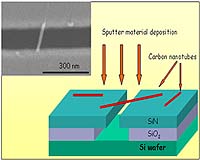
Champaign IL (SPX) Feb 07, 2005 Ultrathin superconducting wires can withstand stronger magnetic fields than larger wires made from the same material, researchers now report. This finding may be useful for technologies that employ superconducting magnets, such as magnetic resonance imaging. As described in the Jan. 14 issue of the journal Physical Review Letters, researchers at the University of Illinois at Urbana-Champaign have created high-quality superconducting wires with molecular dimensions, and measured their behavior in magnetic fields of various strengths. The observational results have confirmed that theories developed for bulk superconductors also apply to molecular-scale superconductors. "Our experimental results show an excellent agreement with the theory of pair-breaking perturbations, even at high magnetic fields," said Alexey Bezryadin, a professor of physics at Illinois. "The theory takes into account both spin and orbital contributions." To study this phenomenon, the researchers began by placing a single-wall carbon nanotube across a narrow trench (about 100 nanometers wide) etched in the surface of a silicon wafer. The nanotube was then coated with a thin film of superconducting material (molybdenum-germanium), chilled below its critical temperature, and its properties measured in the presence of a magnetic field. "Usually, when you apply a magnetic field to a superconductor, the field suppresses or even destroys the superconductivity," Bezryadin said. "The magnetic field pulls apart the two electrons forming Cooper pairs and also rotates their spins. As the superconductor becomes smaller, however, the destructive effects of the magnetic field become weaker." The magnetic field showed a remarkably weak effect on nanowires, the researchers report. Both the orbital and the spin pair-breaking effects were strongly suppressed in the nanowires. The orbital effect was weak because of the small dimensions of the wire (about 10 nanometers in diameter) and the spin effect was weakened by spin-orbit interactions. "One should not set a goal of reducing the wire's diameter indefinitely, however," Bezryadin said. "As the diameter is decreased, disorder and boundary effects become more and more important. These factors also weaken superconductivity." In fact, the researchers' results show that thin wires do not really have zero resistance, as bulk samples do. They also show that the thinner the wire the higher its electrical resistance is. Because nanoscale superconductors don't repel magnetic fields, they could prove useful in a variety of superconducting applications. By incorporating nanowires as filaments in bigger superconducting wires, for example, more current could be carried without being destroyed by a magnetic field. "Again, one needs to optimize the diameters of the wires in order to produce cables with the highest ability to carry strong currents and withstand strong magnetic fields," Bezryadin said. "The nanowire should not be too thick, in order to be less sensitive to magnetic fields; but it also should not be too thin, in order to be fully superconducting. A correct balance should be achieved." Related Links University of Illinois at Urbana-Champaign SpaceDaily Search SpaceDaily Subscribe To SpaceDaily Express
 UPI Energy Watch
 Washington (UPI) Feb 3, 2005
The Britain-based International Oil Pollution Compensation Fund (IOPCF) compensated Bahrain with $1.59 million for an oil spill of approximately 5,000 barrels of crude oil which hit the Muharraq coast on March 8, 2003. IOPCF, an international organization, provides compensation for oil pollution damage caused by oil spills from tankers. |
|
|

| The content herein, unless otherwise known to be public domain, are Copyright 1995-2006 - SpaceDaily.AFP and UPI Wire Stories are copyright Agence France-Presse and United Press International. ESA PortalReports are copyright European Space Agency. All NASA sourced material is public domain. Additionalcopyrights may apply in whole or part to other bona fide parties. Advertising does not imply endorsement,agreement or approval of any opinions, statements or information provided by SpaceDaily on any Web page published or hosted by SpaceDaily. Privacy Statement |