| . |  |
. |
| . | |
. |


Thompson Files: Air tanker dilemmas
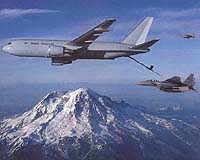
Arlington, Va. (UPI) Sep 24, 2007 The oldest fleet of jets in the world isn't operated by Uzbekistan Airways. It is operated by the U.S. Air Force, which decided in the early 1950s to buy hundreds of Boeing 707s as the backbone of its aerial-refueling fleet. More than 500 of them are still in service, and by the time the next president is sworn in they will have reached an average age of 50 years. How would you like to fly near combat zones in a 50-year-old plane? The Air Force doesn't like that idea at all, and wants to replace the antique tankers as soon as possible -- before they become safety risks. The service is running a competition to decide whether a Boeing plane or an Airbus plane would be better suited to provide the first 179 next-generation tankers. Since the Air Force only has enough money to buy 15 new tankers per year, it could take decades to replace all the Eisenhower-era planes in the fleet. Unfortunately, legislators from Alabama -- whose state stands to benefit from an Airbus win -- want to split the contract between both competing planes. They fear the Air Force will pick the smaller Boeing plane because it can land in more places, uses less space on the ground and burns a ton less aviation fuel per flight hour. The Airbus plane can carry more fuel and cargo, so the Alabama delegation believes a good outcome would be to buy a mix of aircraft that affords access to the best features of both planes. But such "dual sourcing" is a bad idea that would waste billions of dollars without enhancing the performance of the aerial-refueling fleet. Here's why. Higher purchase price: The Boeing and Airbus planes being offered in the competition are commercial airliners that must be modified to serve as tankers. If the Air Force bought both planes, it would have to pay for parallel development programs to reconfigure two very different planes. Once these costly efforts were completed, the service would then have to buy enough planes from each company to keep both production lines running. Sustaining two different lines at a minimum economic rate of 10 planes each per year would raise the Air Force's acquisition costs by well over $1 billion annually compared with just running one line at an efficient rate. This problem will grow worse as commercial demand for both planes disappears in the next decade, forcing the Air Force to pay the full costs of both production lines. Higher operating costs: Buying two different planes means also buying two different supply chains for repair parts, two different sets of maintenance procedures and two different programs for training pilots. If you add that diversity into a tanker fleet that already contains two dissimilar tankers likely to remain in service for decades to come, you end up with a very big annual bill for training and maintenance. Since the lifetime cost of sustaining military aircraft once they are operational typically exceeds the original purchase price, buying two types of future tankers rather than one passes on a huge legacy of unnecessary expenses to future generations of warfighters and taxpayers. Reduced operational flexibility: Even if the Air Force could find the money to keep the various planes in its future aerial-refueling fleet at a high state of readiness, the different performance characteristics of the Boeing and Airbus tankers would impede operational effectiveness. The service would have a grab-bag fleet of two new tankers and two Cold War tankers with dissimilar ranges, payloads, support needs and infrastructure requirements. Mixing and matching this menagerie to cope with rapidly unfolding contingencies would be a nightmare for war planners and logisticians, potentially leading to a loss of life. So Congress should stick with the plan: run a rigorous competition and then buy the best plane, not both of them.
Email This Article Comment On This Article Related Links The Military Industrial Complex at SpaceWar.com Learn about the Superpowers of the 21st Century at SpaceWar.com
 Bush warns North Korea against any nuclear technology proliferation
 Washington (AFP) Sept 20, 2007
US President George W. Bush on Thursday warned North Korea against supplying nuclear know-how to Syria, saying key six-party talks with Pyongyang could only succeed if it met all its pledges. |
|
|

| The content herein, unless otherwise known to be public domain, are Copyright 1995-2007 - SpaceDaily.AFP and UPI Wire Stories are copyright Agence France-Presse and United Press International. ESA Portal Reports are copyright European Space Agency. All NASA sourced material is public domain. Additional copyrights may apply in whole or part to other bona fide parties. Advertising does not imply endorsement,agreement or approval of any opinions, statements or information provided by SpaceDaily on any Web page published or hosted by SpaceDaily. Privacy Statement |