|
 |
 |
 |
 |
 |
 |
 |
 |
 |

| . |  |
. |
Theorists Tackle Mysterious Wake Of Baby Planet
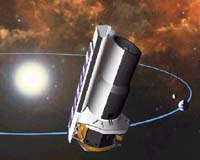
Rochester NY (SPX) Nov 12, 2004 In June, researchers from the University of Rochester announced they had located a potential planet around another star so young that it defied theorists' explanations. Now a new team of Rochester planet-formation specialists are backing up the original conclusions, saying they've confirmed that the hole formed in the star's dusty disk could very well have been formed by a new planet. The findings have implications for gaining insight into how our own solar system came to be, as well as finding other possibly habitable planetary systems throughout our galaxy. "The data suggests there's a young planet out there, but until now none of our theories made sense with the data for a planet so young," says Adam Frank, professor of physics and astronomy at the University of Rochester. "On the one hand, it's frustrating; but on the other, it's very cool because Mother Nature has just handed us the planet and we've got to figure out how it must have been created." Intriguingly, working from the original team's data, Frank, Alice Quillen, Eric Blackman, and Peggy Varniere revealed that the planet was likely smaller than most extra-solar planets discovered thus far�about the size of Neptune. The data also suggested that this planet is about the same distance from its parent star as our own Neptune is from the Sun. Most extra-solar planets discovered to date are much larger and orbit extremely close to their parent star. The original Rochester team, led by Dan Watson, professor of physics and astronomy, used NASA's new Spitzer Space Telescope to detect a gap in the dust surrounding a fledgling star. The critical infrared "eyes" of the infrared telescope were designed in part by physics and astronomy professors Judith Pipher, William Forrest, and Watson, a team that has been among the world leaders in opening the infrared window to the universe. It was Forrest and Pipher who were the first U.S. astronomers to turn an infrared array toward the skies: In 1983, they mounted a prototype infrared detector onto the University telescope in the small observatory on top of the Wilmot Building on campus, taking the first-ever telescopic pictures of the moon in the infrared, a wavelength range of light that is invisible to the naked eye as well as to most telescopes. The discovered gap strongly signaled the presence of a planet. The dust in the disk is hotter in the center near the star and so radiates most of its light at shorter wavelengths than the cooler outer reaches of the disk. The research team found that there was an abrupt dearth of light radiating at all short infrared wavelengths, strongly suggesting that the central part of the disk was absent. Scientists know of only one phenomenon that can tunnel such a distinct "hole" in the disk during the short lifetime of the star�a planet at least 100,000 years old. This possibility of a planet on the order of only 100,000 to half a million years old was met with skepticism by many astronomers because neither of the leading planetary formation models seemed to allow for a planet of this age. Two models represent the leading theories of planetary formation: core accretion and gravitational instability. Core accretion suggests that the dust from which the star and system form begins to clump together into granules, and those granules clump into rocks, asteroids, and planetoids until whole planets are formed. But the theory says it should take about 10 million years for a planet to evolve this way�far too long to account for the half-million-year-old planet found by Watson. Conversely, the other leading theory of planetary formation, gravitational instability, suggests that whole planets could form essentially in one swoop as the original cloud of gas is pulled together by its own gravity and becomes a planet. But while this model suggests that planetary formation could happen much faster�on the order of centuries�the density of the dust disk surrounding the star seems to be too sparse to support this model either. "Even though it doesn't fit either model, we've crunched the numbers and shown that yes, in fact, that hole in that dust disk could have been formed by a planet," says Frank. "Now we have to look at our models and figure out how that planet got there. At the end of it all, we hope we have a new model, and a new understanding of how planets come to be." Related Links Rocherster University SpaceDaily Search SpaceDaily Subscribe To SpaceDaily Express
 Marketing To The Mothership
 Moffett Field CA (SPX) Nov 03, 2004
Within the first month on Mars, the rovers had captured Madison Avenue with fresh possiblities. Earthlings had some new inspiration about what to do with robots and wheels on another planet. Not just motivation, but drive. |
|
|

| The content herein, unless otherwise known to be public domain, are Copyright 1995-2006 - SpaceDaily.AFP and UPI Wire Stories are copyright Agence France-Presse and United Press International. ESA PortalReports are copyright European Space Agency. All NASA sourced material is public domain. Additionalcopyrights may apply in whole or part to other bona fide parties. Advertising does not imply endorsement,agreement or approval of any opinions, statements or information provided by SpaceDaily on any Web page published or hosted by SpaceDaily. Privacy Statement |